
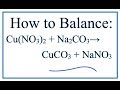
Balancing Chemical Equations Concepts

Interactive Video
•
Chemistry
•
9th - 10th Grade
•
Practice Problem
•
Hard

Aiden Montgomery
FREE Resource
Read more
9 questions
Show all answers
1.
MULTIPLE CHOICE QUESTION
30 sec • 1 pt
What type of reaction occurs between copper(II) nitrate and sodium carbonate?
Decomposition reaction
Synthesis reaction
Double displacement reaction
Single displacement reaction
2.
MULTIPLE CHOICE QUESTION
30 sec • 1 pt
Why is it helpful to consider polyatomic ions as single units in double displacement reactions?
It increases the number of products.
It changes the reaction type.
It simplifies the balancing process.
It makes the reaction faster.
3.
MULTIPLE CHOICE QUESTION
30 sec • 1 pt
Which polyatomic ion is present on both sides of the equation in this reaction?
Nitrate ion
Phosphate ion
Sulfate ion
Hydroxide ion
4.
MULTIPLE CHOICE QUESTION
30 sec • 1 pt
How many sodium atoms are present on the reactant side before balancing?
Four
Two
One
Three
5.
MULTIPLE CHOICE QUESTION
30 sec • 1 pt
What is the first step in balancing the given chemical equation?
Balancing the carbonate ions
Balancing the sodium atoms
Balancing the nitrate ions
Balancing the copper atoms
6.
MULTIPLE CHOICE QUESTION
30 sec • 1 pt
After balancing, how many nitrate ions are present on the product side?
One
Two
Three
Four
7.
MULTIPLE CHOICE QUESTION
30 sec • 1 pt
What is the final balanced equation for the reaction between copper(II) nitrate and sodium carbonate?
Cu(NO3)2 + Na2CO3 → CuCO3 + 2NaNO3
Cu(NO3)2 + Na2CO3 → CuCO3 + NaNO3
Cu(NO3)2 + Na2CO3 → 2CuCO3 + NaNO3
Cu(NO3)2 + Na2CO3 → Cu(NO3)2 + Na2CO3
Access all questions and much more by creating a free account
Create resources
Host any resource
Get auto-graded reports

Continue with Google

Continue with Email

Continue with Classlink

Continue with Clever
or continue with

Microsoft
%20(1).png)
Apple

Others
Already have an account?
Similar Resources on Wayground

11 questions
Code Monkey YouTube Channel Insights
Interactive video
•
9th - 10th Grade
8 questions
Halogen Compounds:Methods of Preparation
Interactive video
•
10th - 12th Grade
11 questions
Understanding Chemical Reactions
Interactive video
•
9th - 12th Grade
11 questions
Understanding Acids and Bases
Interactive video
•
9th - 12th Grade
11 questions
Understanding Thermodynamics: Endothermic and Exothermic Processes
Interactive video
•
10th - 12th Grade
11 questions
SN1 and SN2 Reaction Mechanisms
Interactive video
•
10th - 12th Grade
11 questions
Acid-Base Titration Concepts
Interactive video
•
10th - 12th Grade
11 questions
Chemical Equilibrium Concepts and Characteristics
Interactive video
•
10th - 12th Grade
Popular Resources on Wayground
15 questions
Fractions on a Number Line

Quiz
•
3rd Grade
20 questions
Equivalent Fractions
Quiz
•
3rd Grade
25 questions
Multiplication Facts
Quiz
•
5th Grade
29 questions
Alg. 1 Section 5.1 Coordinate Plane
Quiz
•
9th Grade
22 questions
fractions
Quiz
•
3rd Grade
11 questions
FOREST Effective communication

Lesson
•
KG
20 questions
Main Idea and Details
Quiz
•
5th Grade
20 questions
Context Clues
Quiz
•
6th Grade
Discover more resources for Chemistry
22 questions
Unit 9 Gas Law Quiz
Quiz
•
10th Grade
10 questions
Exploring Types of Chemical Reactions
Interactive video
•
6th - 10th Grade
20 questions
Types of Chemical Reactions
Quiz
•
9th - 12th Grade
20 questions
Acids and Bases
Quiz
•
10th Grade
30 questions
Energy Review
Quiz
•
9th Grade
7 questions
GCSE Chemistry - Balancing Chemical Equations #4
Interactive video
•
9th - 10th Grade
20 questions
Chemistry: Classification of Matter
Quiz
•
10th Grade
40 questions
Unit 3 (Part 1) Chemical Equations & Reactions Review Game
Quiz
•
8th - 12th Grade