
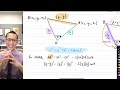
Understanding Vectors and Dot Products

Interactive Video
•
Mathematics
•
9th - 10th Grade
•
Practice Problem
•
Hard

Liam Anderson
FREE Resource
Read more
10 questions
Show all answers
1.
MULTIPLE CHOICE QUESTION
30 sec • 1 pt
What is the main challenge with using the polar formula for the dot product?
It cannot be used with vectors in component form.
It is only applicable in two dimensions.
It requires knowledge of the angle theta.
It is not mathematically rigorous.
2.
MULTIPLE CHOICE QUESTION
30 sec • 1 pt
How does the cosine rule help in expressing the dot product?
It provides a way to calculate the angle theta directly.
It allows the expression of the dot product without theta.
It simplifies the calculation of vector magnitudes.
It is only applicable to right-angled triangles.
3.
MULTIPLE CHOICE QUESTION
30 sec • 1 pt
What is the result of applying the cosine rule to a triangle formed by vectors?
A method to calculate the area of the triangle.
A formula for the magnitude of the vectors.
An expression for the angle theta.
An expression for the dot product independent of theta.
4.
MULTIPLE CHOICE QUESTION
30 sec • 1 pt
What happens to the terms when expanding the squared differences in the dot product derivation?
They all cancel out.
They simplify to zero.
They form a new vector equation.
They result in a complex polynomial.
5.
MULTIPLE CHOICE QUESTION
30 sec • 1 pt
What is the significance of the negative two factor in the dot product derivation?
It is a common factor that can be divided out.
It is a mistake in the calculation.
It is used to calculate vector magnitudes.
It represents the angle between vectors.
6.
MULTIPLE CHOICE QUESTION
30 sec • 1 pt
Why is the polar formula the same in both two and three dimensions?
Because the formula is only valid in two dimensions.
Because a two-dimensional perspective can always be found.
Because the angle between vectors is always zero.
Because vectors are always coplanar.
7.
MULTIPLE CHOICE QUESTION
30 sec • 1 pt
What does the term 'coplanar' mean in the context of vectors?
Vectors that have the same magnitude.
Vectors that are parallel to each other.
Vectors that intersect at a point.
Vectors that lie on the same plane.
Access all questions and much more by creating a free account
Create resources
Host any resource
Get auto-graded reports

Continue with Google

Continue with Email

Continue with Classlink

Continue with Clever
or continue with

Microsoft
%20(1).png)
Apple

Others
Already have an account?
Similar Resources on Wayground
Popular Resources on Wayground

15 questions
Fractions on a Number Line

Quiz
•
3rd Grade
10 questions
Probability Practice
Quiz
•
4th Grade
15 questions
Probability on Number LIne
Quiz
•
4th Grade
20 questions
Equivalent Fractions
Quiz
•
3rd Grade
25 questions
Multiplication Facts
Quiz
•
5th Grade
22 questions
fractions
Quiz
•
3rd Grade
6 questions
Appropriate Chromebook Usage

Lesson
•
7th Grade
10 questions
Greek Bases tele and phon
Quiz
•
6th - 8th Grade
Discover more resources for Mathematics
23 questions
TSI Math Vocabulary
Quiz
•
10th - 12th Grade
15 questions
Graphing Inequalities
Quiz
•
7th - 9th Grade
20 questions
Graphing Inequalities on a Number Line
Quiz
•
6th - 9th Grade
15 questions
Combine Like Terms and Distributive Property
Quiz
•
8th - 9th Grade
10 questions
Plotting Points on a Coordinate Plane: Quadrant 1 Essentials
Interactive video
•
6th - 10th Grade
20 questions
Perfect Squares and Square Roots
Quiz
•
9th Grade
10 questions
Exploring Abiotic and Biotic Factors in Ecosystems
Interactive video
•
6th - 10th Grade
20 questions
Function or Not a Function
Quiz
•
8th - 9th Grade