Quantum Mechanics: Wavefunction Behavior

Interactive Video
•
Physics
•
11th Grade - University
•
Practice Problem
•
Hard

Lucas Foster
FREE Resource
Read more
10 questions
Show all answers
1.
MULTIPLE CHOICE QUESTION
30 sec • 1 pt
What is the main difference between classical and quantum particles when encountering a barrier?
Classical particles can pass through barriers.
Classical particles have wave-like characteristics.
Quantum particles exhibit both particle-like and wave-like behavior.
Quantum particles always reflect off barriers.
2.
MULTIPLE CHOICE QUESTION
30 sec • 1 pt
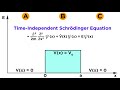
In the potential barrier model, what does region B represent?
The area after the barrier.
The area spanning the barrier.
The area with infinite potential.
The area before the barrier.
3.
MULTIPLE CHOICE QUESTION
30 sec • 1 pt
What phenomenon allows a quantum particle to cross a barrier even if its energy is less than the barrier height?
Quantum bouncing
Quantum jumping
Quantum tunneling
Quantum reflection
4.
MULTIPLE CHOICE QUESTION
30 sec • 1 pt
What is the purpose of introducing the value k-naught in solving the Schrodinger equation?
To simplify the potential energy term.
To define the wavefunction's amplitude.
To eliminate the time-dependence of the equation.
To solve the second order differential equation.
5.
MULTIPLE CHOICE QUESTION
30 sec • 1 pt
Why are real exponentials used in region B when the particle's energy is less than the barrier height?
Because the potential is zero.
Because the wavefunction is expected to decay.
Because the wavefunction is complex.
Because the particle is moving freely.
6.
MULTIPLE CHOICE QUESTION
30 sec • 1 pt
What happens to the wavefunction in region B when the particle's energy is greater than the barrier height?
It disappears.
It becomes a complex exponential.
It remains constant.
It becomes a real exponential.
7.
MULTIPLE CHOICE QUESTION
30 sec • 1 pt
What is the significance of ensuring the wavefunction and its derivative are continuous at the boundaries?
To ensure the wavefunction is normalizable.
To ensure the wavefunction is infinite.
To ensure the wavefunction is zero.
To ensure the wavefunction is physically realistic.
Access all questions and much more by creating a free account
Create resources
Host any resource
Get auto-graded reports

Continue with Google

Continue with Email

Continue with Classlink

Continue with Clever
or continue with

Microsoft
%20(1).png)
Apple

Others
Already have an account?
Popular Resources on Wayground

8 questions
2 Step Word Problems

Quiz
•
KG - University
20 questions
Comparing Fractions
Quiz
•
4th Grade
15 questions
Fractions on a Number Line
Quiz
•
3rd Grade
20 questions
Equivalent Fractions
Quiz
•
3rd Grade
25 questions
Multiplication Facts
Quiz
•
5th Grade
10 questions
Latin Bases claus(clois,clos, clud, clus) and ped
Quiz
•
6th - 8th Grade
22 questions
fractions
Quiz
•
3rd Grade
7 questions
The Story of Books
Quiz
•
6th - 8th Grade