
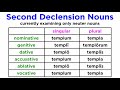
Neuter Nouns in Latin

Interactive Video
•
World Languages
•
9th - 10th Grade
•
Practice Problem
•
Hard

Amelia Wright
FREE Resource
Read more
10 questions
Show all answers
1.
MULTIPLE CHOICE QUESTION
30 sec • 1 pt
What does the etymology of the word 'neuter' suggest about its meaning?
It means both masculine and feminine.
It means neither masculine nor feminine.
It means only masculine.
It means only feminine.
2.
MULTIPLE CHOICE QUESTION
30 sec • 1 pt
Which of the following is a neuter noun in Latin?
Aqua (water)
Incola (inhabitant)
Templum (temple)
Liber (book)
3.
MULTIPLE CHOICE QUESTION
30 sec • 1 pt
Which declension in Latin lacks neuter words?
Third declension
Second declension
First declension
Fourth declension
4.
MULTIPLE CHOICE QUESTION
30 sec • 1 pt
What is the relationship between the endings of neuter nouns and their gender?
Endings only determine feminine nouns.
Endings determine the gender of neuter nouns.
Endings only determine masculine nouns.
Endings have no relation to the gender of neuter nouns.
5.
MULTIPLE CHOICE QUESTION
30 sec • 1 pt
In the declension of neuter nouns, which cases have the same endings?
Nominative and Accusative
Genitive and Dative
Vocative and Ablative
Dative and Ablative
6.
MULTIPLE CHOICE QUESTION
30 sec • 1 pt
In a sentence, how can you determine if 'templ-ŭm' is the subject or the object?
By identifying the vocative case
By checking the word order
By looking at the verb
By analyzing other words in the sentence
7.
MULTIPLE CHOICE QUESTION
30 sec • 1 pt
What is a common challenge when using neuter nouns in sentences?
Using the correct preposition
Determining the subject and object
Identifying the correct verb form
Finding the correct adjective
Access all questions and much more by creating a free account
Create resources
Host any resource
Get auto-graded reports

Continue with Google

Continue with Email

Continue with Classlink

Continue with Clever
or continue with

Microsoft
%20(1).png)
Apple

Others
Already have an account?

