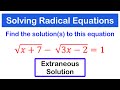
Solving Radical Equations and Verification

Interactive Video
•
Mathematics
•
9th - 10th Grade
•
Practice Problem
•
Hard

Thomas White
FREE Resource
Read more
9 questions
Show all answers
1.
MULTIPLE CHOICE QUESTION
30 sec • 1 pt
What is the first step in solving a radical equation?
Divide both sides by a variable
Remove the radical by squaring both sides
Multiply both sides by a constant
Add a constant to both sides
2.
MULTIPLE CHOICE QUESTION
30 sec • 1 pt
In the equation √(x² + 7) = 4, what is the result after squaring both sides?
x² + 7 = 8
x² + 7 = 4
x² + 7 = 16
x² + 7 = 0
3.
MULTIPLE CHOICE QUESTION
30 sec • 1 pt
What are extraneous solutions?
Solutions that are always positive
Solutions that satisfy the original equation
Solutions that are always negative
Solutions that do not satisfy the original equation
4.
MULTIPLE CHOICE QUESTION
30 sec • 1 pt
How do you verify if a solution is valid for a radical equation?
By checking if it is an integer
By checking if it is a negative number
By checking if it is a positive number
By checking if it satisfies the original equation
5.
MULTIPLE CHOICE QUESTION
30 sec • 1 pt
What is the equation for the second example?
√(x + 7) - √(3x - 2) = 1
√(x + 7) = √(3x - 2)
√(x + 7) + √(3x - 2) = 1
√(x + 7) = 1
6.
MULTIPLE CHOICE QUESTION
30 sec • 1 pt
Why do we transpose terms in the second example?
To divide the equation
To simplify the equation
To eliminate negative terms
To add more terms
7.
MULTIPLE CHOICE QUESTION
30 sec • 1 pt
What happens when you square both sides of the equation √(x + 7) = 1 + √(3x - 2)?
The radicals are eliminated
The equation becomes more complex
The equation remains the same
The equation becomes a linear equation
Access all questions and much more by creating a free account
Create resources
Host any resource
Get auto-graded reports

Continue with Google

Continue with Email

Continue with Classlink

Continue with Clever
or continue with

Microsoft
%20(1).png)
Apple

Others
Already have an account?
Popular Resources on Wayground

15 questions
Fractions on a Number Line

Quiz
•
3rd Grade
20 questions
Equivalent Fractions
Quiz
•
3rd Grade
25 questions
Multiplication Facts
Quiz
•
5th Grade
22 questions
fractions
Quiz
•
3rd Grade
20 questions
Main Idea and Details
Quiz
•
5th Grade
20 questions
Context Clues
Quiz
•
6th Grade
15 questions
Equivalent Fractions
Quiz
•
4th Grade
20 questions
Figurative Language Review
Quiz
•
6th Grade
Discover more resources for Mathematics
20 questions
Graphing Inequalities on a Number Line
Quiz
•
6th - 9th Grade
12 questions
Exponential Growth and Decay
Quiz
•
9th Grade
20 questions
Exponent Rules Review
Quiz
•
8th - 9th Grade
25 questions
Complementary and Supplementary Angles
Quiz
•
7th - 10th Grade
12 questions
Add and Subtract Polynomials
Quiz
•
9th - 12th Grade
13 questions
Model Exponential Growth and Decay Scenarios
Quiz
•
9th - 12th Grade
15 questions
Combine Like Terms and Distributive Property
Quiz
•
8th - 9th Grade
27 questions
7.2.3 Quadrilateral Properties
Quiz
•
9th - 12th Grade