
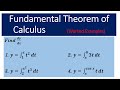
Fundamental Theorem of Calculus Concepts

Interactive Video
•
Mathematics
•
11th - 12th Grade
•
Practice Problem
•
Hard

Thomas White
FREE Resource
Read more
8 questions
Show all answers
1.
MULTIPLE CHOICE QUESTION
30 sec • 1 pt
What is the main connection between differentiation and integration as explained in the introduction?
Integration is the reverse process of differentiation.
Differentiation is the reverse process of integration.
They are both used to find the area under a curve.
They are completely unrelated.
2.
MULTIPLE CHOICE QUESTION
30 sec • 1 pt
According to Part 1 of the Fundamental Theorem of Calculus, what must be true about the function f on a closed interval [a, b]?
f must be linear.
f must be differentiable.
f must be discontinuous.
f must be constant.
3.
MULTIPLE CHOICE QUESTION
30 sec • 1 pt
What does Part 1 of the Fundamental Theorem of Calculus state about the derivative of an integral?
It is equal to the original function.
It is equal to the lower limit of the function.
It is equal to zero.
It is equal to the upper limit of the function.
4.
MULTIPLE CHOICE QUESTION
30 sec • 1 pt
In Part 2 of the Fundamental Theorem of Calculus, what is the result of integrating a function between two constants a and b?
The average of the function values at a and b.
The product of the function values at a and b.
The difference between the function values at a and b.
The sum of the function values at a and b.
5.
MULTIPLE CHOICE QUESTION
30 sec • 1 pt
In the first example problem, what is the derivative of the integral from 1 to x of t squared dt?
2x
0
x squared
x
6.
MULTIPLE CHOICE QUESTION
30 sec • 1 pt
In the second example problem, what adjustment is made when the lower limit is a variable and the upper limit is a constant?
Add a constant to the integral.
Subtract a constant from the integral.
Flip the limits and add a negative sign.
Multiply the integral by a constant.
7.
MULTIPLE CHOICE QUESTION
30 sec • 1 pt
When applying the chain rule in the context of the Fundamental Theorem of Calculus, what must be done if the upper limit is a function of x?
Ignore the upper limit.
Differentiate the upper limit and multiply.
Subtract the upper limit from the integral.
Add the upper limit to the integral.
Access all questions and much more by creating a free account
Create resources
Host any resource
Get auto-graded reports

Continue with Google

Continue with Email

Continue with Classlink

Continue with Clever
or continue with

Microsoft
%20(1).png)
Apple

Others
Already have an account?

