
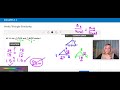
Triangle Similarity and Congruence Concepts

Interactive Video
•
Mathematics
•
9th - 10th Grade
•
Hard

Thomas White
FREE Resource
Read more
7 questions
Show all answers
1.
MULTIPLE CHOICE QUESTION
30 sec • 1 pt
What is the main difference between proving triangles similar and proving them congruent?
Similar triangles have proportional sides and angles.
Congruent triangles have identical angles and side lengths.
Congruent triangles have the same shape but different sizes.
Similar triangles have the same size.
2.
MULTIPLE CHOICE QUESTION
30 sec • 1 pt
What does similarity in triangles imply?
The triangles are dilations of each other.
The triangles are mirror images.
The triangles have no common properties.
All angles and sides are identical.
3.
MULTIPLE CHOICE QUESTION
30 sec • 1 pt
How can you determine if two triangles are similar using their angles?
By rotating one triangle to match the other.
By comparing the lengths of all sides.
By ensuring two angles are congruent.
By checking if all angles are equal.
4.
MULTIPLE CHOICE QUESTION
30 sec • 1 pt
What is the Angle-Angle (AA) Similarity Theorem?
Two triangles are similar if they have the same perimeter.
Two triangles are similar if two angles are congruent.
Two triangles are similar if one angle and one side are congruent.
Two triangles are similar if all sides are proportional.
5.
MULTIPLE CHOICE QUESTION
30 sec • 1 pt
Which theorem states that triangles are similar if all three sides are proportional?
Hypotenuse-Leg (HL) Theorem
Side-Side-Side (SSS) Theorem
Side-Angle-Side (SAS) Theorem
Angle-Angle (AA) Theorem
6.
MULTIPLE CHOICE QUESTION
30 sec • 1 pt
In the context of triangle similarity, what does the Side-Angle-Side (SAS) theorem state?
Two triangles are similar if two sides and the included angle are proportional.
Two triangles are similar if all angles are equal.
Two triangles are similar if they have the same area.
Two triangles are similar if they have one side and one angle equal.
7.
MULTIPLE CHOICE QUESTION
30 sec • 1 pt
How can similarity theorems be applied to real-world problems?
By measuring the angles of a triangle.
By finding the perimeter of a triangle.
By determining the height of an object using shadows.
By calculating the area of a triangle.
Access all questions and much more by creating a free account
Create resources
Host any resource
Get auto-graded reports

Continue with Google

Continue with Email

Continue with Classlink

Continue with Clever
or continue with

Microsoft
%20(1).png)
Apple

Others
Already have an account?

