
Diptongo at Klaster Quiz
Authored by Jeneffer Fraga
English
University
Used 1+ times


AI Actions
Add similar questions
Adjust reading levels
Convert to real-world scenario
Translate activity
More...
Content View
Student View
30 questions
Show all answers
1.
MULTIPLE SELECT QUESTION
30 sec • 1 pt
Select all that applies. Piliin lahat ng salita na may diptonggo at klaster.
basket
Trumpo
kalbo
Batingaw
Maestra
Answer explanation
The question asks to select all words that have both a diphthong (diptonggo) and a consonant cluster (klaster). Let's analyze each word:
•a. Basket:
•Klaster: "sk" (two consonants together in the same syllable)
•Diptonggo: None (the vowels "a" and "e" are in separate syllables: Bas-ket)
•Conclusion: Has a klaster but no diptonggo.
•b. Trumpo:
•Klaster: "tr" (two consonants together in the same syllable) and "mp" (two consonants together in the same syllable)
•Diptonggo: "uo" (a combination of a vowel and a semi-vowel in the same syllable: Trum-po)
•Conclusion: Has both a klaster and a diptonggo.
•c. Maestra:
•Klaster: "tr" (two consonants together in the same syllable)
•Diptonggo: "ae" (a combination of a vowel and a semi-vowel in the same syllable: Ma-es-tra)
•Conclusion: Has both a klaster and a diptonggo.
•d. Kalbo:
•Klaster: "lb" (two consonants together in the same syllable)
•Diptonggo: None (the vowels "a" and "o" are in separate syllables: Kal-bo)
•Conclusion: Has a klaster but no diptonggo.
•e. Tigre:
•Klaster: "gr" (two consonants together in the same syllable)
•Diptonggo: None (the vowels "i" and "e" are in separate syllables: Ti-gre)
•Conclusion: Has a klaster but no diptonggo.
•f. Batingaw:
•Klaster: "ng" (a digraph representing one consonant sound, not a consonant cluster of two distinct consonants)
•Diptonggo: "aw" (a combination of a vowel and a semi-vowel in the same syllable: Ba-ti-ngaw)
•Conclusion: While "ng" is a digraph, the word contains the diphthong "aw". Therefore, considering the broader interpretation of the question to include words with both a diphthong and any sequence of consonants, this would be included. However, strictly speaking, "ng" is a single sound, not a cluster. Despite this nuance, in many basic Filipino language exercises, words with "ng" followed by another consonant or preceded by a consonant alongside a diphthong are often considered. Given the options, this is the most likely intended answer along with 'trumpo' and 'maestra'.
Therefore, based on the presence of both a diphthong and a consonant cluster (or a digraph in the case of 'batingaw' alongside a diphthong), the correct answers are b. Trumpo, c. Maestra, and f. Batingaw.
2.
MULTIPLE CHOICE QUESTION
30 sec • 1 pt
A makahiya plant closes its leaves when touched. Which life process does this plant exhibit?
Locomotion
Movement
Irritability
Growth
Answer explanation
The correct answer is c. Irritability.
Rationalization:
Let's analyze each option in the context of the makahiya plant closing its leaves when touched:
•a. Locomotion: Locomotion refers to the ability of an organism to move from one place to another. The makahiya plant is rooted in the ground and does not move its entire body to a different location when touched. Therefore, this is incorrect.
•b. Movement: Movement is a broader term that refers to a change in position of any part of an organism. The closing of the makahiya plant's leaves is indeed a form of movement. However, there is a more specific term that describes the plant's response to a stimulus.
•c. Irritability: Irritability (also known as sensitivity or responsiveness) is the ability of an organism to detect and respond to changes in its environment (stimuli). In this case, the touch is the stimulus, and the closing of the leaves is the plant's response. The makahiya plant exhibits a rapid and noticeable reaction to this external stimulus. This is a key characteristic of irritability in living organisms.
•d. Growth: Growth is the process of an organism increasing in size over time. While plants grow, the immediate closing of the leaves upon being touched is not an example of growth.
Therefore, the most accurate and specific life process exhibited by the makahiya plant closing its leaves when touched is irritability, as it demonstrates the plant's ability to sense and respond to a stimulus in its environment. While the closing of the leaves is a form of movement, irritability is the life process that explains why the movement occurs in response to the touch.
3.
MULTIPLE CHOICE QUESTION
30 sec • 1 pt
The type of knowledge by Krathwohl arranged from simplest to complex is as follows ____________.
factual – conceptual – procedural – metacognition
conceptual – factual – metacognition – procedural
metacognition – procedural – conceptual – factual
procedural – factual – conceptual - metacognition
Answer explanation
he correct answer is a. factual – conceptual – procedural – metacognition.
Rationalization:
This question refers to the Knowledge Dimension of Bloom's Taxonomy, which was revised by Lorin Anderson and David Krathwohl. Krathwohl was one of the original authors of Bloom's Taxonomy. The Knowledge Dimension outlines a hierarchy of knowledge types, ranging from basic recall to more complex understanding and self-awareness. The order from simplest to most complex is:
•Factual Knowledge: This is the most basic level and involves knowledge of specific terminology and details. It's the "what" – knowing basic facts, terms, and elements.
•Conceptual Knowledge: This level involves understanding the interrelationships among the basic elements within a larger structure that enable them to function together. It's the "why" – understanding categories, principles, generalizations, theories, models, and structures.
•Procedural Knowledge: This level refers to knowledge of how to do something, including skills, techniques, methods, and criteria for determining when to use particular procedures. It's the "how" – knowing how to perform tasks and use specific methods.
•Metacognitive Knowledge: This is the most complex level and involves knowledge about cognition in general, as well as awareness and knowledge of one's own cognition. It's "thinking about thinking" – including strategic knowledge, knowledge about cognitive tasks, and self-knowledge.
Therefore, the correct sequence representing the increasing complexity of knowledge according to Krathwohl's revised Bloom's Taxonomy is factual, conceptual, procedural, and then metacognition.
4.
OPEN ENDED QUESTION
3 mins • 1 pt
Answer TRUE if the statement is correct and CHANGE the underlined word if the statement is FALSE. Philippines is an archipelago composed of 7107 islands.
Evaluate responses using AI:
OFF
5.
OPEN ENDED QUESTION
3 mins • 1 pt
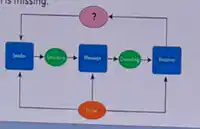
In the communication process, identify what component of communication is missing.
Evaluate responses using AI:
OFF
6.
MULTIPLE CHOICE QUESTION
30 sec • 1 pt
In a faculty meeting, teachers discuss strategies for collaborating with parents and community stakeholders to enhance student learning outcomes. Which domain of the PPST emphasizes the importance of such collaboration?
Domain 1
Domain 2
Domain 6
Domain 7
7.
FILL IN THE BLANKS QUESTION
30 sec • 1 pt
Jenny is a 5-year old girl. She has a favorite stuffed toy named Teddy. Jenny believes that Teddy is alive and has feelings just like she does. One day, Jenny accidentally drops Teddy on the floor, and Teddy’s are falls off, Jenny becomes upset and apologizes to Teddy, saying, “I’m sorry, Teddy! Are you okay? Does it hurt? She then tries to comfort Teddy by hugging him tightly and promising to be more careful. Under Piaget’s Stages of Cognitive Development, Jenny exhibits a characteristics called (a)
Answer explanation
Under Piaget's Stages of Cognitive Development, Jenny exhibits the characteristic called animism.
Rationalization:
Jean Piaget's preoperational stage (roughly ages 2 to 7) is characterized by several key cognitive limitations and developing abilities. One of these limitations is animism, which is the belief that inanimate objects have lifelike qualities, such as feelings, intentions, or thoughts.
In the scenario described:
•Jenny believes Teddy is alive and has feelings: This is a direct manifestation of animistic thinking. She attributes the quality of being alive and having emotions to her stuffed toy.
•Jenny apologizes to Teddy and asks if it hurts: By apologizing and expressing concern about Teddy's well-being after dropping him, Jenny is treating the inanimate object as if it can experience pain and understand apologies.
•Jenny comforts Teddy: Her attempt to hug and reassure Teddy further demonstrates her belief that the stuffed toy has feelings and can be comforted, a hallmark of animistic thought.
Therefore, Jenny's behavior of attributing life and feelings to her stuffed toy Teddy, and acting towards it as if it were a living being capable of experiencing harm and comfort, is a clear example of animism, a characteristic of the preoperational stage in Piaget's theory of cognitive development.
Access all questions and much more by creating a free account
Create resources
Host any resource
Get auto-graded reports

Continue with Google

Continue with Email

Continue with Microsoft
or continue with

%20(1).png)
Apple

Others
By signing up, you agree to our Terms of Service & Privacy Policy
Already have an account?


