
Acid-Base Regulation Part 2
Authored by Shaira Tabligan
Health Sciences
Professional Development
Used 4+ times


AI Actions
Add similar questions
Adjust reading levels
Convert to real-world scenario
Translate activity
More...
Content View
Student View
9 questions
Show all answers
1.
MULTIPLE CHOICE QUESTION
1 min • 1 pt
A 65-year-old man had a heart attack and experiences cardiopulmonary arrest while being transported to the emergency department. Use the following laboratory values obtained from arterial blood to answer the question
Plasma pH = 7.12
Plasma PCO2 = 60 mm Hg
Plasma HCO3- concentration = 19 mEq/L
Question: Which of the following options best describes his acid-base disorder?
Respiratory acidosis with partial renal compensation
Metabolic acidosis with partial respiratory compensation
Mixed acidosis: combined metabolic and respiratory acidosis
Mixed alkalosis: combined respiratory and metabolic alkalosis
Answer explanation
Rationale: C) Because the patient has a low plasma pH (normal = 7.4), he has acidosis. The fact that his plasma bicarbonate concentration is also low (normal = 24 mEq/l) indicates that he has metabolic acidosis. However, he also appears to have respiratory acidosis because his plasma is high (normal = 40 mm Hg). The rise in is due to his impaired breathing as a result of cardiopulmonary arrest. Therefore, the patient has a mixed acidosis with combined metabolic and respiratory acidosis
2.
MULTIPLE CHOICE QUESTION
1 min • 1 pt
A 65-year-old man had a heart attack and experiences cardiopulmonary arrest while being transported to the emergency department. Use the following laboratory values obtained from arterial blood to answer the question
Plasma pH = 7.12
Plasma PCO2 = 60 mm Hg
Plasma HCO3- concentration = 19 mEq/L
In this patient, which of the following laboratory results would be expected, compared with normal?
Increased renal excretion of bicarbonate
Decreased urinary titratable acid
Increased urine pH
Increased renal excretion of ammonia (NH4 +)
Answer explanation
Rationale: D) An important compensation for respiratory acidosis is increased renal production of NH4 + and increased NH4 + excretion. In acidosis, urinary excretion of would be reduced, as would urine pH, and urinary titratable acid would be slightly increased as a compensatory response to the acidosis.
3.
MULTIPLE CHOICE QUESTION
1 min • 1 pt
What is the most likely cause of his acidosis if the patient has the following laboratory values:
arterial pH = 7.13
plasma HC03 = 15mEq/L
plasma chloride concentration = 118 mEq/l
arterial pCO2= 28 mm Hg
plasma Na+ concentration = 141 mEq/l.
Salicylic acid poisoning
Diabetes mellitus
Diarrhea
Emphysema
Answer explanation
Rationale: C) The patient has a lower than normal pH and is therefore acidotic. Because the plasma bicarbonate concentration is also lower than normal, the patient has metabolic acidosis with respiratory compensation (i.e., is lower than normal). The plasma anion gap is in the normal range, suggesting that the metabolic acidosis is not caused by excess nonvolatile acids such as salicylic acid or ketoacids caused by diabetes mellitus. Therefore, the most likely cause of the metabolic acidosis is diarrhea, which would cause a loss of in the feces and would be associated with a normal anion gap and a hyperchloremic (increased chloride concentration) metabolic acidosis.
4.
MULTIPLE CHOICE QUESTION
1 min • 1 pt
Using the laboratory values calculate the plasma anion gap and what it corresponds to.
Use this formula to calculate: Anion Gap = Na⁺ - (Cl⁻ + HCO₃⁻)
arterial pH = 7.13
plasma HC03 = 15mEq/L
plasma chloride concentration = 118 mEq/l
arterial pCO2= 28 mm Hg
plasma Na+ concentration = 141 mEq/l.
7mEq/L, normal
8 mEq/L, suggesting diarrhea
8 mEq/L, acidosis due to hypochloremia
Answer explanation
Rationale: B.) Anion Gap: 141- (118 + 15) = 8. Normal anion gap (8 to 12 mEq/L) in the presence of acidosis suggests causes like diarrhea, renal tubular acidosis, or acetazolamide use. The patient has hyperchloremia with 118 Cl concentration.
5.
MULTIPLE CHOICE QUESTION
1 min • 1 pt
Which of the following is a cause of metabolic alkalosis?
Diarrhea
Chronic renal failure
Ethylene glycol ingestion
Treatment with acetazolamide
Hyperaldosteronism
Answer explanation
Rationale: A cause of metabolic alkalosis is hyperaldosteronism; increased aldosterone levels cause increased H+ secretion by the distal tubule and increased reabsorption of “new” HCO3−. Diarrhea causes loss of HCO3− from the gastrointestinal (GI) tract and acetazolamide causes loss of HCO3− in the urine, both resulting in hyperchloremic metabolic acidosis with normal anion gap. Ingestion of ethylene glycol and salicylate poisoning leads to metabolic acidosis with increased anion gap
6.
MULTIPLE CHOICE QUESTION
1 min • 1 pt
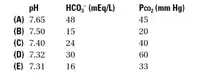
Which set of arterial blood values describes a patient with chronic renal failure (eating a normal protein diet) and decreased urinary excretion of NH4+?
a
b
c
d
e
Answer explanation
Rationale: E. In patients who have chronic renal failure and ingest normal amounts of protein, fixed acids will be produced from the catabolism of protein. Because the failing kidney does not produce enough NH4+ to excrete all of the fixed acid, metabolic acidosis (with respiratory compensation) results.
7.
MULTIPLE CHOICE QUESTION
1 min • 1 pt
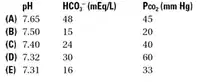
Which set of arterial blood values describes a patient with untreated diabetes mellitus and increased urinary excretion of NH4+?
a
b
c
d
e
Answer explanation
Rationale: E. Untreated diabetes mellitus results in the production of keto acids, which are fixed acids that cause metabolic acidosis. Urinary excretion of NH4+ is increased in this patient because an adaptive increase in renal NH3 synthesis has occurred in response to the metabolic acidosis.
Access all questions and much more by creating a free account
Create resources
Host any resource
Get auto-graded reports

Continue with Google

Continue with Email

Continue with Classlink

Continue with Clever
or continue with

Microsoft
%20(1).png)
Apple

Others
Already have an account?

