
Comparing Theoretical and Experimental Probabilities to Observed Frequencies
Authored by Kartik Garg
Mathematics
7th Grade
CCSS covered


AI Actions
Add similar questions
Adjust reading levels
Convert to real-world scenario
Translate activity
More...
Content View
Student View
29 questions
Show all answers
1.
MULTIPLE CHOICE QUESTION
1 min • 1 pt
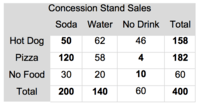
What is the relative frequency of people that purchased no food?
Hint : what does "of people" mean?
10%
60%
15%
30%
2.
MULTIPLE CHOICE QUESTION
1 min • 1 pt

A random sample of traffic tickets given to motorists in a large city is examined. The tickets are classified according to the race of the driver. The results are summarized in the table provided. Assuming H0 is true, the expected number of Hispanic drivers who would receive a ticket is
10.4
11
11.8
12
3.
MULTIPLE CHOICE QUESTION
1 min • 1 pt

The best estimate for the relative frequency in B is
57% =77-20
17%=37-20
6%=63-57
6%=23-17
Tags
CCSS.6.SP.B.5
CCSS.6.SP.A.2
CCSS.6.SP.A.1
4.
MULTIPLE CHOICE QUESTION
1 min • 1 pt
The best estimate for the relative frequency in C is
57% =77-20
17%=37-20
6%=63-57
6%=23-17
Tags
CCSS.6.SP.B.5
CCSS.6.SP.A.2
CCSS.6.SP.A.1
5.
MULTIPLE CHOICE QUESTION
1 min • 1 pt

According to the table, what is the relative frequency of students ages 10 - 13 who eat breakfast?
About 33%
About 50%
About 40%
About 44%
Tags
CCSS.6.SP.B.5
CCSS.6.SP.A.2
CCSS.6.RP.A.1
CCSS.6.RP.A.3
6.
MULTIPLE CHOICE QUESTION
1 min • 1 pt
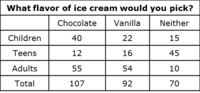
Given the person is a child, what is the conditional relative frequency that they would pick neither?
.26
.195
.286
.214
7.
MULTIPLE CHOICE QUESTION
1 min • 1 pt

What is the relative frequency of female students?
48%
51%
26%
23%
28%
Access all questions and much more by creating a free account
Create resources
Host any resource
Get auto-graded reports

Continue with Google

Continue with Email

Continue with Classlink

Continue with Clever
or continue with

Microsoft
%20(1).png)
Apple

Others
Already have an account?

