
8.1 Responses to the Environment
Authored by Tracy Holtz
Biology
9th - 12th Grade
NGSS covered


AI Actions
Add similar questions
Adjust reading levels
Convert to real-world scenario
Translate activity
More...
Content View
Student View
12 questions
Show all answers
1.
REORDER QUESTION
1 min • 1 pt
Place the times in the correct order to represent the hierarchy for the level of ecology, from the simplest to the most complex.
Individual (Organism)
Ecosystem
Community
Biome
Population
2.
REORDER QUESTION
1 min • 1 pt
Place the times in the correct order to represent the hierarchy for the level of ecology, from the simplest to the most complex.
group of the same species
only one
groups of different species interacting
biotic and abiotic factors interacting
3.
MULTIPLE CHOICE QUESTION
30 sec • 1 pt
Which statement about response to environmental stimuli is true?
Short-day plants flower when there is a long photoperiod
Plants experiencing phototropism move toward sunlight
Navigating birds lack and internal compass, so they rely on stars.
A circadian clock operates during daylight hours
4.
MULTIPLE CHOICE QUESTION
30 sec • 1 pt
Which statement about communication is false?
Brightly colored flowers communicate a source of nectar to pollinators.
Rattlesnakes use auditory communication when threatened.
Animals mark their territories using chemical communication.
Plants are unable to use chemical communication.
5.
MULTIPLE SELECT QUESTION
45 sec • 1 pt
Which statement is true about innate or learned (adaptive) behaviors?
Innate behaviors are performed better over time
Imprinting on a parent is an example of innate behavior
Imitation is an example of a learned behavior
Courtship displays in birds are commonly learned behaviors
6.
MULTIPLE CHOICE QUESTION
30 sec • 1 pt
Which statement about social behavior is false?
The fitness costs of social living outweigh the fitness benefits
Benefits include the ability of predators to capture and subdue large prey
Costs include having to share food with other members of the same species
Some species are highly social, living in groups that number in the thousands.
Tags
NGSS.HS-LS2-8
7.
MULTIPLE CHOICE QUESTION
30 sec • 1 pt
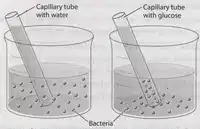
Students conduct an experiment with a population of bacteria named Alcaligenes faecalis. These bacteria move by using a tail-like structure called a flagellum. The students place two groups of bacteria into two beakers containing the same medium. The students place a capillary tube containing water into the first beaker, and they place a capillary tube filled with glucose dissolved water into the second tube. Both the water and glucose can diffuse out of the capillary tubes and into the medium into the beakers. The students observe the movements of the bacteria in both beakers. After a period of time, the students record the location of the bacteria in the beakers, which are represented by the dots in the figure.
Identify the independent variable in the experiment.
The presence of glucose
The presence of Alcaligenes faecalis
The presence of the water-containing capillary tube
The presence of the medium into which Alcaligenes faecalis are placed.
Tags
NGSS.MS-LS2-1
NGSS.MS-LS2-4
Access all questions and much more by creating a free account
Create resources
Host any resource
Get auto-graded reports

Continue with Google

Continue with Email

Continue with Microsoft
or continue with

%20(1).png)
Apple

Others
Already have an account?


