
TKA Descriptive quiz
Authored by Anggraini Diah S
English
9th - 12th Grade


AI Actions
Add similar questions
Adjust reading levels
Convert to real-world scenario
Translate activity
More...
Content View
Student View
10 questions
Show all answers
1.
CATEGORIZE QUESTION
3 mins • 1 pt
Chongqing: A Visionary Smart City of the People's Republic of China
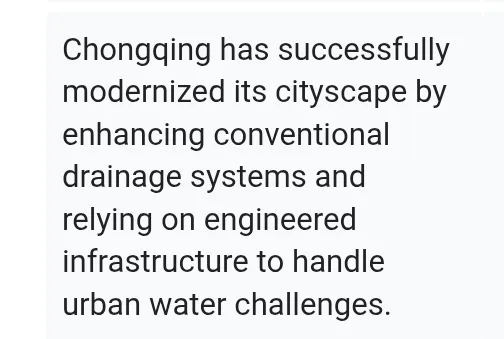
Chongqing, one of China's four direct-controlled municipalities, has rapidly transformed into a symbol offuturistic urban development. Known for its mountainous landscape and dense skyline and located at the confluence of the Yangtze and Jialing Rivers, Chongqing implements smart urban strategies, such as the sponge city concept, a new model of sustainable urban development.
As one of China's first pilot sponge cities since 2015, Chongqing has prioritized nature-based solutions to manage urban flooding, stormwater, and pollution. For instance, its Yubei Central Park features floating gardens that absorb rainwater and reduce surface runoff while providing cooling green spaces. By 2020, Chongqing had developed over 626.9 square kilometers of sponge infrastructure, covering more than 34% of its urbanized land.
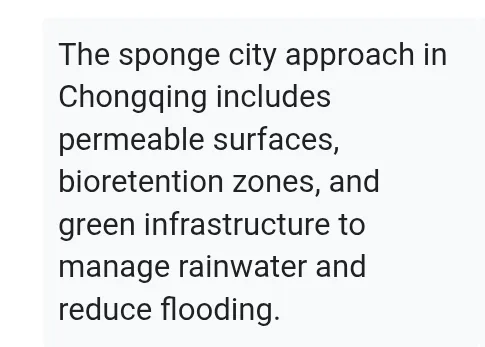
Technically,the sponge city system integrates permeable surfaces, bioretention areas, and green-blue infrastructure to slow down rainwater, filter pollutants, and reuse water for irrigation and public use. In Yuelai New City, porous pavements and vegetated rooftops not only collect and purify rainwater but also release it gradually into the environment, reducing pressure on drainage systems.
Chongaing also combines these eco-friendly designs with advanced smart city technologies, such as 5G networks and Internet of Things (IoT) systems, to monitor water quality, manage automated drainage, and respond quickly to extreme weather conditions. This integration makes Chongqing a model of a climate-adaptive, data-driven urban ecosystem. In short, Chongqing demonstrates how green infrastructure and digital innovation can be merged to create a livable, resilient, and futuristic city.
Adopted from: ⁃ HuiLi,Liugian Ding, Minglei Ren, & et al/Multidisciplinary Digital Publishing Institute, 2017 -Tan Yingzi and Deng Rui/China Daily, 2023
Identify which statements accurately represent the summary of the text.
Click Accurate or Inaccurate for each statement!
Groups:
(a) Accurate
,
(b) Inaacurate
2.
MULTIPLE CHOICE QUESTION
30 sec • 1 pt
Chongqing: A Visionary Smart City of the People's Republic of China
Chongqing, one of China's four direct-controlled municipalities, has rapidly transformed into a symbol offuturistic urban development. Known for its mountainous landscape and dense skyline and located at the confluence of the Yangtze and Jialing Rivers, Chongqing implements smart urban strategies, such as the sponge city concept, a new model of sustainable urban development.
As one of China's first pilot sponge cities since 2015, Chongqing has prioritized nature-based solutions to manage urban flooding, stormwater, and pollution. For instance, its Yubei Central Park features floating gardens that absorb rainwater and reduce surface runoff while providing cooling green spaces. By 2020, Chongqing had developed over 626.9 square kilometers of sponge infrastructure, covering more than 34% of its urbanized land.
Technically,the sponge city system integrates permeable surfaces, bioretention areas, and green-blue infrastructure to slow down rainwater, filter pollutants, and reuse water for irrigation and public use. In Yuelai New City, porous pavements and vegetated rooftops not only collect and purify rainwater but also release it gradually into the environment, reducing pressure on drainage systems.
Chongaing also combines these eco-friendly designs with advanced smart city technologies, such as 5G networks and Internet of Things (IoT) systems, to monitor water quality, manage automated drainage, and respond quickly to extreme weather conditions. This integration makes Chongqing a model of a climate-adaptive, data-driven urban ecosystem. In short, Chongqing demonstrates how green infrastructure and digital innovation can be merged to create a livable, resilient, and futuristic city.
Adopted from: ⁃ HuiLi,Liugian Ding, Minglei Ren, & et al/Multidisciplinary Digital Publishing Institute, 2017 -Tan Yingzi and Deng Rui/China Daily, 2023
Which of the following is the main topic of the text?*
The role of the Yangtze and Jialing Rivers in Chongqing's water sustainability strategies
The implementation of sponge city technology in Chongqing's green infrastructure
The transformation of Chongqing into a futuristic and sustainable smart city
The impact of green rooftops and porous pavements in reducing urban flooding in Yuelai New City
How Chongqing uses 5G networks and loT systems to manage water and drainage
3.
MULTIPLE SELECT QUESTION
45 sec • 1 pt
Chongqing: A Visionary Smart City of the People's Republic of China
Chongqing, one of China's four direct-controlled municipalities, has rapidly transformed into a symbol offuturistic urban development. Known for its mountainous landscape and dense skyline and located at the confluence of the Yangtze and Jialing Rivers, Chongqing implements smart urban strategies, such as the sponge city concept, a new model of sustainable urban development.
As one of China's first pilot sponge cities since 2015, Chongqing has prioritized nature-based solutions to manage urban flooding, stormwater, and pollution. For instance, its Yubei Central Park features floating gardens that absorb rainwater and reduce surface runoff while providing cooling green spaces. By 2020, Chongqing had developed over 626.9 square kilometers of sponge infrastructure, covering more than 34% of its urbanized land.
Technically,the sponge city system integrates permeable surfaces, bioretention areas, and green-blue infrastructure to slow down rainwater, filter pollutants, and reuse water for irrigation and public use. In Yuelai New City, porous pavements and vegetated rooftops not only collect and purify rainwater but also release it gradually into the environment, reducing pressure on drainage systems.
Chongaing also combines these eco-friendly designs with advanced smart city technologies, such as 5G networks and Internet of Things (IoT) systems, to monitor water quality, manage automated drainage, and respond quickly to extreme weather conditions. This integration makes Chongqing a model of a climate-adaptive, data-driven urban ecosystem. In short, Chongqing demonstrates how green infrastructure and digital innovation can be merged to create a livable, resilient, and futuristic city.
Adopted from: ⁃ HuiLi,Liugian Ding, Minglei Ren, & et al/Multidisciplinary Digital Publishing Institute, 2017 -Tan Yingzi and Deng Rui/China Daily, 2023
Which of the following statements best represent the main ideas presented by the writer?
There is more than one correct answer, Click on every correct answer!
Chongqing's natural landscape and rivers support its transformation into a sustainable and futuristic city.
The sponge city concept helps Chongqingmanage water issues and improve environmental quality.
Chongqing's success is supported by its integration of smart technologies such as 5G networks and loT systems.
By combining green infrastructure and smart technology, Chongaing becomes a model for futur. sustainable cities.
The development of Yubei Central Park and Yuelai New City illustrates how sponge city principles ar applied.
4.
MULTIPLE SELECT QUESTION
45 sec • 1 pt
Chongqing: A Visionary Smart City of the People's Republic of China
Chongqing, one of China's four direct-controlled municipalities, has rapidly transformed into a symbol offuturistic urban development. Known for its mountainous landscape and dense skyline and located at the confluence of the Yangtze and Jialing Rivers, Chongqing implements smart urban strategies, such as the sponge city concept, a new model of sustainable urban development.
As one of China's first pilot sponge cities since 2015, Chongqing has prioritized nature-based solutions to manage urban flooding, stormwater, and pollution. For instance, its Yubei Central Park features floating gardens that absorb rainwater and reduce surface runoff while providing cooling green spaces. By 2020, Chongqing had developed over 626.9 square kilometers of sponge infrastructure, covering more than 34% of its urbanized land.
Technically,the sponge city system integrates permeable surfaces, bioretention areas, and green-blue infrastructure to slow down rainwater, filter pollutants, and reuse water for irrigation and public use. In Yuelai New City, porous pavements and vegetated rooftops not only collect and purify rainwater but also release it gradually into the environment, reducing pressure on drainage systems.
Chongaing also combines these eco-friendly designs with advanced smart city technologies, such as 5G networks and Internet of Things (IoT) systems, to monitor water quality, manage automated drainage, and respond quickly to extreme weather conditions. This integration makes Chongqing a model of a climate-adaptive, data-driven urban ecosystem. In short, Chongqing demonstrates how green infrastructure and digital innovation can be merged to create a livable, resilient, and futuristic city.
Adopted from: ⁃ HuiLi,Liugian Ding, Minglei Ren, & et al/Multidisciplinary Digital Publishing Institute, 2017 -Tan Yingzi and Deng Rui/China Daily, 2023
Which of the following conclusions can reasonably be drawn from the supporting details in the text? There is more than one correct answer. Click on every correct answer!
Chongqing's sponge city project has successfullv turned the city into a major international tourist destination.
Sponge city design helps reduce flood risks and enhances water management in urban areas
The integration of eco-friendly design and smart technology supports sustainable and climate-resilient urban planning.
Green infrastructure in Chongqing has improved public awareness about the importance of environmenta protection.
Urban innovation in Chongqing proves that technology alone can solve complex climate issues in large cities.
5.
MULTIPLE CHOICE QUESTION
30 sec • 1 pt
Labuan Bajo's Tourism Growth
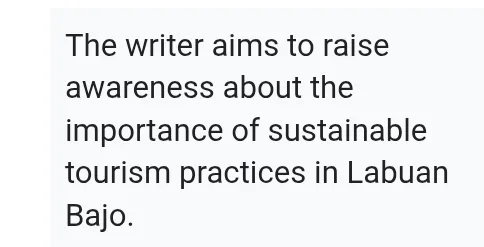
Labuan Bajo is a small port town located on the western tip of Flores island, East Nusa Tenggara, Indonesia. Once a quiet ishing village, Labuan Bajo has become one of lindonesia's top tourist destinations. It is known for its rich marine life, exotic landscapes, and unique culture. The area is also known as the entry point to Komodo National Park, home to the famous Komodo dragons.
Surrounded by turquoise waters and small lush islands, Labuan Bajo offers breath-taking views both above and below the sea. Its marine ecosystem includes coral reefs, dolphins, manta rays, and colorful tropical fish, making it a paradise for divers and snorkelers. Komodo National Park, a UNESCO World Heritage Site, is also located nearby and protects endangered species and fragile ecosystems.
To support sustainability, various local and international efforts have been made. Waste management initiatives, coral reef protection, and community-based tourism programs are being developed to reduce environmental impact. The government has improved infrastructure while still preserving the natural beauty of the area. visitors are encouraged to follow eco-friendly practices and respect local traditions. These combined efforts help ensure that tourism benefits local communities and protects the ocean's biodiversity.
Based on the information presented in the text, who is most likely the intended audience of the passage about Labuan Bajo?
Marine biologists interested in coral reef restoration programs.
Government officials responsible for developing tourism infrastructure
Travelers interested in sustainable tourism and eco-friendly destinations
Divers and snorkelers who support ocean protection and local waste programs
Environmental activists who want to monitor the impact of tourism on local communi
6.
MULTIPLE SELECT QUESTION
45 sec • 1 pt
Labuan Bajo's Tourism Growth
Labuan Bajo is a small port town located on the western tip of Flores island, East Nusa Tenggara, Indonesia. Once a quiet ishing village, Labuan Bajo has become one of lindonesia's top tourist destinations. It is known for its rich marine life, exotic landscapes, and unique culture. The area is also known as the entry point to Komodo National Park, home to the famous Komodo dragons.
Surrounded by turquoise waters and small lush islands, Labuan Bajo offers breath-taking views both above and below the sea. Its marine ecosystem includes coral reefs, dolphins, manta rays, and colorful tropical fish, making it a paradise for divers and snorkelers. Komodo National Park, a UNESCO World Heritage Site, is also located nearby and protects endangered species and fragile ecosystems.
To support sustainability, various local and international efforts have been made. Waste management initiatives, coral reef protection, and community-based tourism programs are being developed to reduce environmental impact. The government has improved infrastructure while still preserving the natural beauty of the area. visitors are encouraged to follow eco-friendly practices and respect local traditions. These combined efforts help ensure that tourism benefits local communities and protects the ocean's biodiversity.
From the text, what can be inferred about the writer's attitude toward Labuan Bajo and its development as a tourist destination?
There is more than one correct answer. Click on every correct answer!
The writer encourages government expansion of tourism infrastructure to attract global investors.
The writer considers Labuan Bajo a place where nature and tourism can coexist harmoniously.
The writer suggests that increasing tourist access is the most effective way to promote local culture.
The writer seems amazed by the unique landscape and vibrant marine life of Labuan Bajo.
The writer supports Labuan Bajo as a site for luxury tourism development due to its exotic appeal.
7.
CATEGORIZE QUESTION
3 mins • 1 pt
Labuan Bajo's Tourism Growth
Labuan Bajo is a small port town located on the western tip of Flores island, East Nusa Tenggara, Indonesia. Once a quiet ishing village, Labuan Bajo has become one of lindonesia's top tourist destinations. It is known for its rich marine life, exotic landscapes, and unique culture. The area is also known as the entry point to Komodo National Park, home to the famous Komodo dragons.
Surrounded by turquoise waters and small lush islands, Labuan Bajo offers breath-taking views both above and below the sea. Its marine ecosystem includes coral reefs, dolphins, manta rays, and colorful tropical fish, making it a paradise for divers and snorkelers. Komodo National Park, a UNESCO World Heritage Site, is also located nearby and protects endangered species and fragile ecosystems.
To support sustainability, various local and international efforts have been made. Waste management initiatives, coral reef protection, and community-based tourism programs are being developed to reduce environmental impact. The government has improved infrastructure while still preserving the natural beauty of the area. visitors are encouraged to follow eco-friendly practices and respect local traditions. These combined efforts help ensure that tourism benefits local communities and protects the ocean's biodiversity.
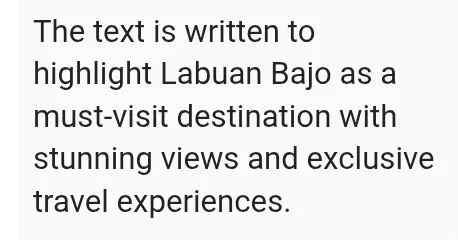
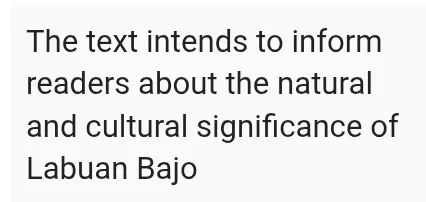
Identify which of the following statements explain the possible background for why the text was written. Click Correct or Incorrect or every statement
Groups:
(a) Correct
,
(b) Incorrect


Access all questions and much more by creating a free account
Create resources
Host any resource
Get auto-graded reports

Continue with Google

Continue with Email

Continue with Classlink

Continue with Clever
or continue with

Microsoft
%20(1).png)
Apple

Others
Already have an account?



