
Activity 1.6 Gear Ratios
Authored by Stacey Torell
English
8th Grade
CCSS covered
Used 1+ times


AI Actions
Add similar questions
Adjust reading levels
Convert to real-world scenario
Translate activity
More...
Content View
Student View
14 questions
Show all answers
1.
MULTIPLE CHOICE QUESTION
30 sec • 1 pt
A student claims: “If the driving gear is smaller than the driven gear, the output speed will increase.” Using the idea of gear ratio and the note that the left gear is driving and the right gear is driven, evaluate the claim.
The claim is correct because a smaller driving gear always turns a larger driven gear faster.
The claim is incorrect; a smaller driving gear driving a larger driven gear decreases output speed.
The claim cannot be evaluated without knowing torque.
The claim is correct only when both gears have the same number of teeth.
2.
MULTIPLE CHOICE QUESTION
30 sec • 1 pt
When calculating gear ratio using number of teeth, which gear’s teeth go in the numerator to match the same ratio value?
Teeth of driving gear
Teeth of driven gear
Average teeth of both gears
Teeth of the idler gear
3.
MULTIPLE CHOICE QUESTION
30 sec • 1 pt
A student calculates gear ratio as rotations of driven gear over rotations of driving gear. To keep the same numerical value using teeth, which expression should they use?
Teeth of driven gear over teeth of driving gear
Teeth of driving gear over teeth of driven gear
Teeth of driving gear plus teeth of driven gear
Teeth of driven gear minus teeth of driving gear
4.
MULTIPLE CHOICE QUESTION
30 sec • 1 pt
You need to increase torque at the output while accepting a reduction in speed. Which tooth-count choice best meets this goal for a single gear pair?
Driving gear has fewer teeth than the driven gear.
Driving gear and driven gear have the same teeth.
Driving gear has more teeth than the driven gear.
Teeth count does not affect torque.
5.
MULTIPLE CHOICE QUESTION
30 sec • 1 pt
Consider a two-gear system intended to keep output speed equal to input speed. Which pair achieves this using teeth counts?
36T driving to 12T driven
30T driving to 30T driven
24T driving to 72T driven
15T driving to 45T driven
6.
MULTIPLE CHOICE QUESTION
30 sec • 1 pt
In a gear train, the driving gear has 16 teeth and the driven gear has 64 teeth. Using teeth-count ratios, what happens to speed and torque at the driven gear?
Speed increases 4×; torque decreases 4×.
Speed decreases 4×; torque increases 4×.
Speed stays the same; torque stays the same.
Speed increases 2×; torque increases 2×.
7.
MULTIPLE CHOICE QUESTION
30 sec • 1 pt
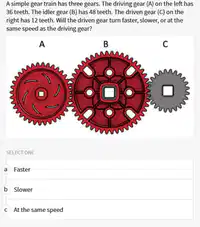
Use proportional reasoning with teeth counts to decide which gear in the train A (36T) → B (48T) → C (12T) will have the greatest angular speed.
Gear A
Gear B
Gear C
All have equal speed


Access all questions and much more by creating a free account
Create resources
Host any resource
Get auto-graded reports

Continue with Google

Continue with Email

Continue with Classlink

Continue with Clever
or continue with

Microsoft
%20(1).png)
Apple

Others
Already have an account?



