
Measurement, Motion & Mass vs Weight
Authored by Mawita Beckford
Physics
10th Grade
NGSS covered


AI Actions
Add similar questions
Adjust reading levels
Convert to real-world scenario
Translate activity
More...
Content View
Student View
20 questions
Show all answers
1.
MULTIPLE CHOICE QUESTION
30 sec • 1 pt
A metre rule is used to measure a length. Which reading is shown to the nearest millimetre?
0.7 m
0.76 m
0.761 m
0.7614 m
Answer explanation
The correct reading to the nearest millimetre is 0.761 m, as it provides three decimal places, which is necessary for millimetre precision. The other options either round too early or do not meet the required precision.
2.
MULTIPLE CHOICE QUESTION
30 sec • 1 pt
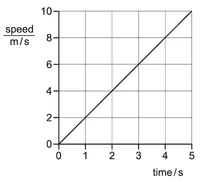
The graph represents the movement of a body. How far has the body moved after 5 s?
2 m
10 m
25 m
50 m
Answer explanation
The graph shows the distance covered by the body over time. At 5 seconds, the graph indicates a total movement of 25 m, making this the correct answer.
3.
MULTIPLE CHOICE QUESTION
30 sec • 1 pt
A car travels 100 km. The highest speed of the car is 90 km/h, and the lowest speed is 30 km/h. The journey takes two hours. What is the average speed for the journey?
30 km/h
50 km/h
60 km/h
90 km/h
Answer explanation
To find the average speed, divide the total distance by the total time. The car travels 100 km in 2 hours, so the average speed is 100 km / 2 h = 50 km/h. Thus, the correct answer is 50 km/h.
4.
MULTIPLE CHOICE QUESTION
30 sec • 1 pt
Which statement about the masses and weights of objects on the Earth is correct?
A balance can only be used to compare weights, not masses.
Heavy objects always have more mass than light ones.
Large objects always have more mass than small ones.
Mass is a force but weight is not.
Answer explanation
The correct statement is that heavy objects always have more mass than light ones. Mass is a measure of the amount of matter in an object, while weight is the force exerted by gravity on that mass.
5.
MULTIPLE CHOICE QUESTION
30 sec • 1 pt

The table shows the weight in newtons of a 10 kg mass on each of four planets. The diagram shows a force meter (spring balance) being used. On which planet is the force meter (spring balance) being used?
Earth
Jupiter
Mercury
Venus
Answer explanation
The weight of a 10 kg mass is highest on Earth due to its gravitational pull. The force meter (spring balance) would show the weight corresponding to Earth's gravity, making Earth the correct choice.
6.
MULTIPLE CHOICE QUESTION
30 sec • 1 pt
Which items of apparatus are required to determine the density of a liquid?
balance and measuring cylinder
balance and thermometer
metre rule and measuring cylinder
metre rule and thermometer
Answer explanation
To determine the density of a liquid, you need a balance to measure mass and a measuring cylinder to measure volume. The correct choice is 'balance and measuring cylinder'.
7.
MULTIPLE CHOICE QUESTION
30 sec • 1 pt

The diagram shows an enlarged drawing of the end of a metre rule. It is being used to measure the length of a small feather.
What is the length of the feather?
19 mm
29 mm
19 cm
29 cm
Answer explanation
The feather measures 19 mm on the metre rule, as indicated by the markings. The other options in cm are incorrect conversions, making 19 mm the accurate length.


Access all questions and much more by creating a free account
Create resources
Host any resource
Get auto-graded reports

Continue with Google

Continue with Email

Continue with Classlink

Continue with Clever
or continue with

Microsoft
%20(1).png)
Apple

Others
Already have an account?

