
Unit 2 Test - AP Environmental Science
Authored by Martha Judge
Science
University
NGSS covered
Used 1+ times


AI Actions
Add similar questions
Adjust reading levels
Convert to real-world scenario
Translate activity
More...
Content View
Student View
21 questions
Show all answers
1.
MULTIPLE CHOICE QUESTION
30 sec • 1 pt
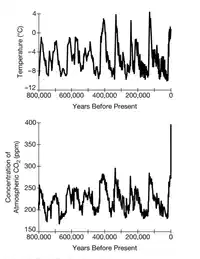
Refer to the graphs showing Temperature (°C) and Concentration of Atmospheric CO2 (ppm) over the past 800,000 years. What general relationship can be observed between atmospheric CO2 concentration and temperature over this period?
As CO2 concentration increases, temperature decreases
As CO2 concentration increases, temperature increases
There is no relationship between CO2 concentration and temperature
Temperature remains constant regardless of CO2 concentration
Tags
NGSS.HS-ESS2-4
NGSS.HS-ESS2-6
NGSS.HS-ESS3-5
2.
MULTIPLE CHOICE QUESTION
30 sec • 1 pt
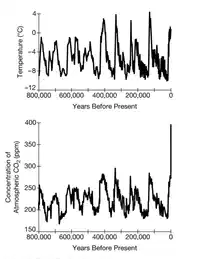
Refer to the graphs showing Temperature (°C) and Concentration of Atmospheric CO2 (ppm) over the past 800,000 years. What is the approximate current concentration of atmospheric CO2 (at 0 years before present)?
About 400 ppm
About 200 ppm
About 280 ppm
About 350 ppm
Tags
NGSS.MS-ESS3-5
3.
MULTIPLE CHOICE QUESTION
30 sec • 1 pt
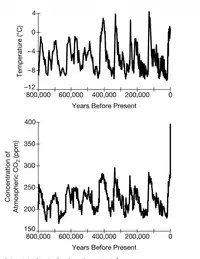
Refer to the graphs showing Temperature (°C) and Concentration of Atmospheric CO2 (ppm) over the past 800,000 years. True or False: The current temperature and CO2 concentration are both higher than at any other point in the past 800,000 years.
True
False
Tags
NGSS.MS-ESS3-5
4.
MULTIPLE CHOICE QUESTION
30 sec • 1 pt
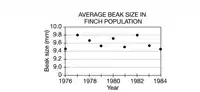
Researchers in the Galápagos Islands measured the average beak size in a population of finches from 1976 to 1984, as shown in the graph below. Birds with smaller beaks are better suited for grasses and soft seeds, while birds with larger beaks are better suited for seeds and nuts. In years with less rainfall, there are fewer grasses to feed on and the finches rely more on seeds for food. In 1977, 1980, and 1982, there were droughts, and the area experienced significantly less rainfall than average. Which statement is best supported by the data in the graph?
Finches were better able to find mates, and the population size increased in 1977 because of the abundance of grasses.
Finches with larger beaks were more likely to survive in 1980 because they were able to feed primarily on seeds and nuts during the drought.
The average beak size in 1981 increased to 9.8 mm because finches had access to unlimited resources.
The finch population declined from 1983 to 1984 due to a decrease in habitat.
Tags
NGSS.MS-LS2-4
NGSS.MS-LS2-1
NGSS.MS-LS4-4
5.
MULTIPLE CHOICE QUESTION
30 sec • 1 pt
A one-hectare pond is sampled in early September. The sample yields 1 small catfish as well as 17 benthic invertebrates that represent 10 species. If the pond is resampled a year later, which of the following would best indicate that the pond had been adversely affected by adjacent development?
An uncommon species has become more numerous.
An increase in low-tolerance species has occurred.
A decrease in high-tolerance species has occurred.
Phylogenetic diversity has increased.
The biodiversity of the pond has decreased.
Tags
NGSS.MS-LS2-4
NGSS.MS-LS2-1
6.
MULTIPLE CHOICE QUESTION
30 sec • 1 pt
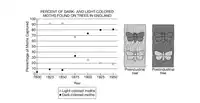
Researchers examined the effect of industrialization and increased pollution (soot) in London on the coloration in a single species of moths. Birds prey on the moths that are easily visible on trees. The researchers observed moths on tree trunks and recorded their body color. The percentage of moths with light colored bodies and the percentage of moths with dark bodies is shown on the graph above. Based on the data in the graph, which of the following best describes the change in the population of moths as a result of industrialization?
The percentage of dark colored moths increased in the population and the percentage of light-colored moths decreased in the population.
The percentage of dark-colored moths decreased in the population and the percentage of light-colored moths increased in the population.
The percentage of dark colored moths decreased in the population after 1850 and the percentage light-colored moths remained constant throughout the time period.
The percentage of both the dark-colored moths and the light-colored moths remained constant throughout the time period.
Tags
NGSS.MS-LS2-4
NGSS.MS-LS4-4
7.
MULTIPLE CHOICE QUESTION
30 sec • 1 pt
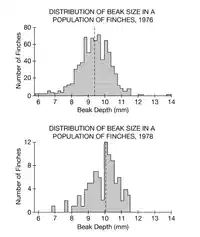
The graphs below show the population size and distribution of beak sizes in a finch population on the island of Daphne Major in the Galapagos in 1976 and 1978. Smaller-beaked finches are better suited for eating grasses and small seeds. Larger-beaked finches are better suited for cracking larger seeds and nuts. In 1977 a drought took place and the vegetation of the island was affected by the lack of rain. Based on the graphs, what happened to the average beak size of the finch population from 1976 to 1978?
It increased
It decreased
It stayed the same
There is not enough information to tell
Tags
NGSS.MS-LS2-4
NGSS.MS-LS2-1
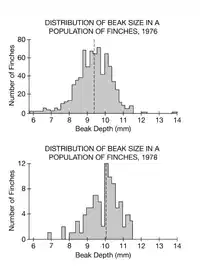
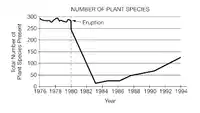
Access all questions and much more by creating a free account
Create resources
Host any resource
Get auto-graded reports

Continue with Google

Continue with Email

Continue with Classlink

Continue with Clever
or continue with

Microsoft
%20(1).png)
Apple

Others
Already have an account?

