
Chapter 6: Chemistry of life
Authored by Dylan Radovich
Other Sciences
9th Grade
Used 4+ times


AI Actions
Add similar questions
Adjust reading levels
Convert to real-world scenario
Translate activity
More...
Content View
Student View
40 questions
Show all answers
1.
MULTIPLE CHOICE QUESTION
30 sec • 1 pt
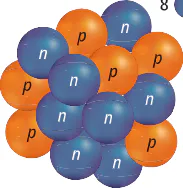
Which statement best describes isotopes of the same element?
They have the same number of protons but different numbers of neutrons.
They have different numbers of protons and the same number of neutrons.
They have the same number of protons and neutrons but different numbers of electrons.
They always have the same mass number.
2.
MULTIPLE CHOICE QUESTION
30 sec • 1 pt
Which statement best distinguishes a chemical change from a physical change when forming a compound?
A chemical change creates a new substance with different properties, while a physical change does not create a new substance.
Both chemical and physical changes create new substances with new properties.
A physical change creates a compound, while a chemical change only changes the state of matter.
Neither chemical nor physical changes alter the identity of the substances involved.
3.
MULTIPLE CHOICE QUESTION
30 sec • 1 pt
Which reagent is used in this MiniLab to test for the presence of simple sugars such as glucose, indicated by a color change?
Biuret solution
Benedict’s solution
Iodine solution
Silver nitrate
4.
MULTIPLE CHOICE QUESTION
30 sec • 1 pt
You prepare four test tubes with different food samples, add Benedict’s solution, and warm them in a 40–50°C water bath for 2–3 minutes. Which step best explains the purpose of warming the test tubes?
It sterilizes the samples to prevent contamination.
It accelerates the color-change reaction that indicates simple sugars.
It evaporates water to concentrate the samples.
It cools the solution to stop the reaction.
5.
MULTIPLE CHOICE QUESTION
30 sec • 1 pt
Which statement best describes van der Waals forces as presented in this section?
They are strong bonds formed by sharing electrons equally between atoms.
They are attractive forces between regions of slight positive and negative charge on nearby molecules.
They are the forces that hold protons and neutrons together in the nucleus.
They are the transfer of electrons from one atom to another creating ions.
6.
MULTIPLE CHOICE QUESTION
30 sec • 1 pt
What causes temporary areas of slight positive and negative charge that lead to van der Waals attractions?
Electrons in a molecule remain fixed in place.
Random motion of electrons can create an unequal distribution of the electron cloud.
Protons move outside the nucleus creating charge imbalances.
Neutrons convert into protons creating local charges.
7.
MULTIPLE CHOICE QUESTION
30 sec • 1 pt
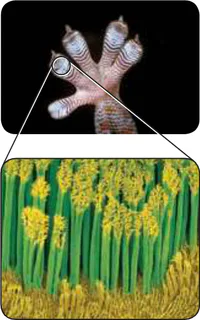
Why can geckos climb smooth surfaces, according to the section?
They produce glue-like secretions that harden on contact.
They have claws that scratch microscopic grooves for grip.
Van der Waals forces form between atoms in the hairlike structures on their toes and the surface.
Their toes are magnetized and attract metal surfaces.

Access all questions and much more by creating a free account
Create resources
Host any resource
Get auto-graded reports

Continue with Google

Continue with Email

Continue with Microsoft
or continue with

%20(1).png)
Apple

Others
By signing up, you agree to our Terms of Service & Privacy Policy
Already have an account?

