
Thermal Energy and Equilibrium — Worksheet Extraction
Authored by NENA BELL
Science
7th Grade
NGSS covered
Used 7+ times


AI Actions
Add similar questions
Adjust reading levels
Convert to real-world scenario
Translate activity
More...
Content View
Student View
6 questions
Show all answers
1.
MULTIPLE CHOICE QUESTION
30 sec • 1 pt
Lotti is enjoying a cup of hot chocolate outside on a cool day and wants to investigate how the 10°C air affects the temperature of her drink. She measures the temperature of the hot chocolate at different intervals until the temperature stops changing. Describe what is happening to thermal energy and what the resulting temperature of her drink is.
Thermal energy moves from the air to the hot chocolate until the final temperature of the chocolate is 10°C.
Thermal energy moves from the hot chocolate to the air until the final temperature of the chocolate is 5°C.
Thermal energy moves from the air to the hot chocolate until the final temperature of the chocolate is 25°C.
Thermal energy moves from the hot chocolate to the air until the final temperature of the chocolate is 10°C.
Answer explanation
Thermal energy transfers from the hot chocolate to the cooler air, causing the drink's temperature to decrease until it reaches thermal equilibrium at 10°C, the temperature of the surrounding air.
Tags
NGSS.MS-PS1-4
2.
MULTIPLE CHOICE QUESTION
30 sec • 1 pt
A student is baking a cake at home. He mixes together all the ingredients and puts the batter into a hot oven. The batter ______ thermal energy until the batter and the air in the oven are the same ______. Once this occurs, __________________________ has been reached. Which of the terms best complete the paragraph?
loses; mass; thermal energy
gains; temperature; thermal equilibrium
gains; state of matter; conduction
loses; temperature; thermal equilibrium
Answer explanation
The batter gains thermal energy as it heats up in the oven. This process continues until the batter and the air reach the same temperature, indicating that thermal equilibrium has been achieved.
Tags
NGSS.MS-PS1-4
NGSS.MS-PS3-4
3.
MULTIPLE CHOICE QUESTION
30 sec • 1 pt
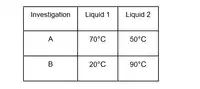
A student is conducting two different investigations to test how thermal energy is transferred when equal amounts of liquid at different temperatures are poured into two different sides of the same container. The two sides are separated from each other by aluminum foil. The conditions for the two investigations are below. Investigation A: Liquid 1 is 70°C and Liquid 2 is 50°C. Investigation B: Liquid 1 is 20°C and Liquid 2 is 90°C. In which investigation will the liquids reach thermal equilibrium first, and why?
Investigation A; Since the temperatures are closer together, less thermal energy will move from the warm water to the cool water. It will take less time to transfer less energy.
Investigation A; Since the temperatures are closer together, less thermal energy will move from the cool water to the warm water. It will take less time to transfer less energy.
Investigation B; Since the temperatures are farther apart, more thermal energy will move from the warm water to the cool water. It will take less time to transfer more energy.
Investigation B; Since the temperatures are farther apart, less energy will move from the cool water to the warm water. It will take less time to transfer less energy.
Answer explanation
Investigation A will reach thermal equilibrium first because the temperatures of the liquids are closer together. This results in less thermal energy needing to be transferred, allowing for a quicker equilibrium.
Tags
NGSS.MS-PS3-4
NGSS.MS-PS3-3
4.
MULTIPLE CHOICE QUESTION
30 sec • 1 pt
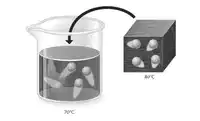
Look at the image of the liquid and the block. What will happen when the block is placed into the liquid?
Energy will transfer from the liquid to the block because thermal energy moves from warmer temperatures to cooler temperatures.
Energy will transfer from the liquid to the block because thermal energy moves from more massive substances to less massive substances.
Energy will transfer from the block to the liquid because thermal energy moves from cooler temperatures to warmer temperatures.
Energy will transfer from the block to the liquid because thermal energy moves from more massive substances to less massive substances.
Answer explanation
When the block is placed in the liquid, thermal energy transfers from the warmer liquid to the cooler block, as energy moves from higher to lower temperatures.
Tags
NGSS.MS-PS1-4
5.
OPEN ENDED QUESTION
3 mins • 3 pts
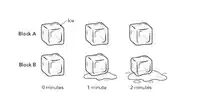
The image shows an investigation that used ice cubes placed on two different blocks at different time intervals. How is thermal energy being transferred during each time interval, and how does this differ between the two blocks?
Evaluate responses using AI:
OFF
Answer explanation
Thermal energy is transferred from the blocks to the ice cubes through conduction. The block with higher thermal conductivity will transfer energy more efficiently, causing the ice to melt faster compared to the other block.
Tags
NGSS.MS-PS1-4
NGSS.MS-PS3-4
6.
OPEN ENDED QUESTION
3 mins • 3 pts
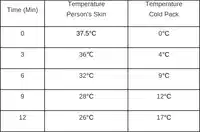
A classmate is investigating how energy is transferred when a cold pack is used on a person’s body. The setup shows a cold pack placed on skin, and the table below records temperatures over time. Predict what the temperature of the person's skin and the cold pack will be after 15 minutes and beyond. Explain your reasoning using evidence from the investigation and your knowledge of thermal energy transfer.
Evaluate responses using AI:
OFF
Answer explanation
After 15 minutes, the cold pack will be warmer, and the skin temperature will decrease. Energy transfers from the skin to the cold pack, cooling the skin and warming the pack until thermal equilibrium is approached.
Tags
NGSS.MS-PS1-4
NGSS.MS-PS3-4
NGSS.MS-PS3-3
Access all questions and much more by creating a free account
Create resources
Host any resource
Get auto-graded reports

Continue with Google

Continue with Email

Continue with Classlink

Continue with Clever
or continue with

Microsoft
%20(1).png)
Apple

Others
Already have an account?
Similar Resources on Wayground

11 questions
A1 Investigative skills 2

Quiz
•
5th - 9th Grade
10 questions
SKS M1 Sceince basic units of organism
Quiz
•
7th Grade
10 questions
STRUCTURAL ADAPTATIONS TO ABIOTIC FACTORS
Quiz
•
6th - 7th Grade
10 questions
Monthly quiz, october 2023, G7
Quiz
•
7th Grade
10 questions
Module 9: Elements and Compounds
Quiz
•
7th Grade
7 questions
Changes around us
Quiz
•
KG - Professional Dev...
10 questions
KSSM_FORM 4_CHAPTER 11_11.3_
Quiz
•
1st - 12th Grade
10 questions
C2-13 Ionic compounds
Quiz
•
7th Grade
Popular Resources on Wayground
15 questions
Fractions on a Number Line
Quiz
•
3rd Grade
10 questions
Probability Practice
Quiz
•
4th Grade
15 questions
Probability on Number LIne
Quiz
•
4th Grade
20 questions
Equivalent Fractions
Quiz
•
3rd Grade
25 questions
Multiplication Facts
Quiz
•
5th Grade
22 questions
fractions
Quiz
•
3rd Grade
6 questions
Appropriate Chromebook Usage

Lesson
•
7th Grade
10 questions
Greek Bases tele and phon
Quiz
•
6th - 8th Grade
Discover more resources for Science
6 questions
Appropriate Chromebook Usage
Lesson
•
7th Grade
42 questions
Academic Bowl Questions - Round 2
Quiz
•
7th Grade
10 questions
Exploring the Rock Cycle

Interactive video
•
6th - 8th Grade
12 questions
Ecological Succession
Quiz
•
7th Grade
8 questions
Newton's Second Law
Lesson
•
6th - 8th Grade
10 questions
Exploring the Rock Cycle: Types and Formation
Interactive video
•
6th - 8th Grade
25 questions
Cell Structure
Lesson
•
7th Grade
25 questions
Evolution and Natural Selection Review
Quiz
•
6th - 8th Grade