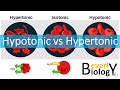
Hypotonic vs Hypertonic Solutions Explained

Interactive Video
•
Biology
•
6th - 10th Grade
•
Practice Problem
•
Easy

Lucas Foster
Used 2+ times
FREE Resource
10 questions
Show all answers
1.
MULTIPLE CHOICE QUESTION
30 sec • 1 pt
What are the two main components of a solution?
Solute and Solvent
Water and Sugar
Osmosis and Diffusion
Cell and Membrane
2.
MULTIPLE CHOICE QUESTION
30 sec • 1 pt
In a biological solution, what is typically the solvent?
Water
Salt
Sugar
Protein
3.
MULTIPLE CHOICE QUESTION
30 sec • 1 pt
What does it mean for a cell membrane to be semipermeable?
All molecules can pass through
No molecules can pass through
Only certain molecules can pass through
It is impermeable to water
4.
MULTIPLE CHOICE QUESTION
30 sec • 1 pt
Which type of solution has a lower concentration of solutes?
Equilibrium
Isotonic
Hypertonic
Hypotonic
5.
MULTIPLE CHOICE QUESTION
30 sec • 1 pt
What happens to a cell placed in a hypotonic solution?
It loses water
It remains the same
It shrivels
It swells and may burst
6.
MULTIPLE CHOICE QUESTION
30 sec • 1 pt
In a hypertonic solution, where does water move?
It moves randomly
Into the cell
Out of the cell
It stays in place
7.
MULTIPLE CHOICE QUESTION
30 sec • 1 pt
What is the concentration of solutes in a hypertonic solution compared to a hypotonic solution?
Lower
Higher
Unchanged
Equal
Access all questions and much more by creating a free account
Create resources
Host any resource
Get auto-graded reports

Continue with Google

Continue with Email

Continue with Classlink

Continue with Clever
or continue with

Microsoft
%20(1).png)
Apple

Others
Already have an account?
Popular Resources on Wayground

15 questions
Fractions on a Number Line

Quiz
•
3rd Grade
20 questions
Equivalent Fractions
Quiz
•
3rd Grade
25 questions
Multiplication Facts
Quiz
•
5th Grade
22 questions
fractions
Quiz
•
3rd Grade
20 questions
Main Idea and Details
Quiz
•
5th Grade
20 questions
Context Clues
Quiz
•
6th Grade
15 questions
Equivalent Fractions
Quiz
•
4th Grade
20 questions
Figurative Language Review
Quiz
•
6th Grade
Discover more resources for Biology
20 questions
Cell Organelles
Quiz
•
10th Grade
20 questions
Cell Organelles
Quiz
•
9th Grade
20 questions
DNA & Protein Synthesis
Quiz
•
9th Grade
7 questions
Amoeba Sisters Dihybrid Cross Punnett Square
Interactive video
•
9th - 12th Grade
25 questions
photosynthesis and cellular respiration
Quiz
•
9th Grade
20 questions
Human Body Systems
Quiz
•
9th Grade
19 questions
Natural Selection
Quiz
•
9th Grade
20 questions
Pedigree Practice
Quiz
•
9th Grade