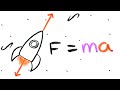
Exploring Newton's Laws of Motion

Interactive Video
•
Science
•
6th - 10th Grade
•
Practice Problem
•
Hard
+1
Standards-aligned

Sophia Harris
FREE Resource
Standards-aligned
10 questions
Show all answers
1.
MULTIPLE CHOICE QUESTION
30 sec • 1 pt
What does Newton's First Law of Motion state about a body at rest or in uniform motion?
It will remain at rest or in uniform motion unless acted upon by a resultant force.
It will eventually come to a stop due to friction.
It will accelerate indefinitely.
It will change its state of motion on its own.
2.
MULTIPLE CHOICE QUESTION
30 sec • 1 pt
According to Newton's Second Law, what is the relationship between force and momentum?
Force is equal to the change in momentum.
Force is proportional to the rate of change of momentum.
Force is inversely proportional to the change in momentum.
Force is independent of momentum.
Tags
NGSS.HS-PS2-1
NGSS.HS-PS2-2
3.
MULTIPLE CHOICE QUESTION
30 sec • 1 pt
How is momentum defined?
The product of mass and acceleration.
The product of mass and velocity.
The product of force and time.
The product of velocity and time.
4.
MULTIPLE CHOICE QUESTION
30 sec • 1 pt
In the given example, what is the initial momentum of the lorry?
30,000 kilogram meters per second
200,000 kilogram meters per second
50,000 kilogram meters per second
100,000 kilogram meters per second
5.
MULTIPLE CHOICE QUESTION
30 sec • 1 pt
What does the negative sign in the calculated braking force indicate?
The force is acting in the direction of motion.
The force is acting in the opposite direction to the motion.
The force is negligible.
The force is constant.
6.
MULTIPLE CHOICE QUESTION
30 sec • 1 pt
What does Newton's Third Law of Motion state about forces between two bodies?
The forces are unequal in magnitude and in the same direction.
The forces are unequal in magnitude and opposite in direction.
The forces are equal in magnitude and in the same direction.
The forces are equal in magnitude and opposite in direction.
Tags
NGSS.MS-PS2-1
7.
MULTIPLE CHOICE QUESTION
30 sec • 1 pt
Why does your hand hurt when you punch a wall, according to Newton's Third Law?
The wall exerts no force.
Your hand is not strong enough.
The wall absorbs all the force.
The wall exerts a force equal in magnitude but opposite in direction to the force exerted by your hand.
Tags
NGSS.MS-PS2-1
Access all questions and much more by creating a free account
Create resources
Host any resource
Get auto-graded reports

Continue with Google

Continue with Email

Continue with Classlink

Continue with Clever
or continue with

Microsoft
%20(1).png)
Apple

Others
Already have an account?
Similar Resources on Wayground
Popular Resources on Wayground

15 questions
Fractions on a Number Line

Quiz
•
3rd Grade
20 questions
Equivalent Fractions
Quiz
•
3rd Grade
25 questions
Multiplication Facts
Quiz
•
5th Grade
22 questions
fractions
Quiz
•
3rd Grade
20 questions
Main Idea and Details
Quiz
•
5th Grade
20 questions
Context Clues
Quiz
•
6th Grade
15 questions
Equivalent Fractions
Quiz
•
4th Grade
20 questions
Figurative Language Review
Quiz
•
6th Grade
Discover more resources for Science
33 questions
Grade 6 Quarter 3 PMA 5 Review
Quiz
•
6th - 8th Grade
85 questions
Midpoint D1 Review
Quiz
•
8th Grade
20 questions
Rocks and The Rock Cycle
Quiz
•
6th Grade
12 questions
Ecological Succession
Quiz
•
7th Grade
12 questions
Newton's Laws of Motion

Lesson
•
6th - 8th Grade
10 questions
Exploring the Rock Cycle: Types and Formation
Interactive video
•
6th - 8th Grade
10 questions
Exploring the Layers of the Earth
Interactive video
•
6th - 10th Grade
20 questions
Pure Substances & Mixtures
Quiz
•
8th Grade