
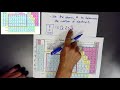
Orbital Notation and Electron Configuration for S and P Orbitals

Interactive Video
•
Chemistry
•
6th - 10th Grade
•
Practice Problem
•
Easy

Liam Anderson
Used 2+ times
FREE Resource
Read more
10 questions
Show all answers
1.
MULTIPLE CHOICE QUESTION
30 sec • 1 pt
What was the analogy used in the previous lesson to explain orbital notation?
A garden with flowers
A house with rooms and bunk beds
A school with classrooms
A library with bookshelves
2.
MULTIPLE CHOICE QUESTION
30 sec • 1 pt
In orbital notation, how are electrons represented?
Arrows
Letters
Numbers
Dots
3.
MULTIPLE CHOICE QUESTION
30 sec • 1 pt
According to Aufbau's principle, which energy levels are filled first?
Lower energy levels
Random energy levels
Higher energy levels
Middle energy levels
4.
MULTIPLE CHOICE QUESTION
30 sec • 1 pt
What does Hund's rule state about electron placement in suborbitals?
Electrons must pair up first
Electrons must fill higher energy levels first
Electrons must be single in a suborbital before pairing
Electrons must spin in opposite directions
5.
MULTIPLE CHOICE QUESTION
30 sec • 1 pt
What is the atomic number of oxygen?
7
9
8
6
6.
MULTIPLE CHOICE QUESTION
30 sec • 1 pt
In the periodic table, which region represents the s orbital?
Blue box
Yellow box
Green box
Red box
7.
MULTIPLE CHOICE QUESTION
30 sec • 1 pt
How many suborbitals does the p orbital have?
1
2
3
4
Access all questions and much more by creating a free account
Create resources
Host any resource
Get auto-graded reports

Continue with Google

Continue with Email

Continue with Microsoft
or continue with

%20(1).png)
Apple

Others
Already have an account?


