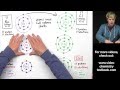
Exploring Ionic Bonding with Sodium Chloride

Interactive Video
•
Chemistry
•
6th - 10th Grade
•
Practice Problem
•
Medium

Ethan Morris
Used 2+ times
FREE Resource
10 questions
Show all answers
1.
MULTIPLE CHOICE QUESTION
30 sec • 1 pt
What is the main goal of an atom in terms of its valence shell?
To have an equal number of protons and electrons
To have more protons than electrons
To have a full valence shell
To have more electrons than protons
2.
MULTIPLE CHOICE QUESTION
30 sec • 1 pt
How many protons and electrons does a neutral sodium atom have?
11 protons and 11 electrons
10 protons and 11 electrons
12 protons and 11 electrons
11 protons and 10 electrons
3.
MULTIPLE CHOICE QUESTION
30 sec • 1 pt
What is the atomic number of chlorine?
18
10
17
11
4.
MULTIPLE CHOICE QUESTION
30 sec • 1 pt
Why is sodium considered 'unhappy' in its neutral state?
It has more protons than electrons
It has a full valence shell
It has only one electron in its valence shell
It has too many electrons
5.
MULTIPLE CHOICE QUESTION
30 sec • 1 pt
What happens to sodium's valence shell when it gives an electron to chlorine?
It disappears and a new full valence shell is formed
It remains the same
It gains more electrons
It becomes negatively charged
6.
MULTIPLE CHOICE QUESTION
30 sec • 1 pt
What charge does chlorine acquire after gaining an electron from sodium?
Positive charge
No charge
Negative charge
Neutral charge
7.
MULTIPLE CHOICE QUESTION
30 sec • 1 pt
What is the resulting charge on sodium after it loses an electron?
No charge
Positive charge
Negative charge
Neutral charge
Access all questions and much more by creating a free account
Create resources
Host any resource
Get auto-graded reports

Continue with Google

Continue with Email

Continue with Classlink

Continue with Clever
or continue with

Microsoft
%20(1).png)
Apple

Others
Already have an account?
Similar Resources on Wayground

11 questions
Electron Configuration and Indium Properties
Interactive video
•
9th - 10th Grade
9 questions
Understanding the Periodic Table
Interactive video
•
8th - 10th Grade
3 questions
Mineral (biology)
Interactive video
•
6th - 12th Grade
3 questions
Metales alcalinos
Interactive video
•
4th - 9th Grade
9 questions
Helium Isotopes and Atomic Mass
Interactive video
•
9th - 10th Grade
2 questions
Metales
Interactive video
•
4th - 9th Grade
2 questions
Carga eléctrica
Interactive video
•
4th - 9th Grade
11 questions
Molecular Geometry of H2SO4
Interactive video
•
9th - 10th Grade
Popular Resources on Wayground
15 questions
Fractions on a Number Line

Quiz
•
3rd Grade
20 questions
Equivalent Fractions
Quiz
•
3rd Grade
25 questions
Multiplication Facts
Quiz
•
5th Grade
22 questions
fractions
Quiz
•
3rd Grade
20 questions
Main Idea and Details
Quiz
•
5th Grade
20 questions
Context Clues
Quiz
•
6th Grade
15 questions
Equivalent Fractions
Quiz
•
4th Grade
20 questions
Figurative Language Review
Quiz
•
6th Grade
Discover more resources for Chemistry
20 questions
Types of Chemical Reactions
Quiz
•
9th - 12th Grade
20 questions
Counting Atoms
Quiz
•
8th Grade
20 questions
Energy Transformations
Quiz
•
9th - 12th Grade
24 questions
Chemical changes
Quiz
•
8th Grade
20 questions
Periodic Table & Trends
Quiz
•
10th Grade
20 questions
Periodic Trends
Quiz
•
10th Grade
24 questions
Identifying Types of Chemical Reactions
Quiz
•
10th - 12th Grade
13 questions
Bill Nye - Energy
Interactive video
•
6th Grade