
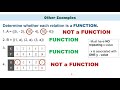
Identifying Functions Through Relations and Graphs

Interactive Video
•
Mathematics
•
6th - 10th Grade
•
Practice Problem
•
Hard
Standards-aligned

Olivia Brooks
FREE Resource
Standards-aligned
Read more
10 questions
Show all answers
1.
MULTIPLE CHOICE QUESTION
30 sec • 1 pt
What makes a function a special type of relation?
Each y-value can be associated with multiple x-values.
Each y-value must be associated with only one x-value.
Each x-value must be associated with only one y-value.
Each x-value can be associated with multiple y-values.
Tags
CCSS.8.F.A.1
2.
MULTIPLE CHOICE QUESTION
30 sec • 1 pt
In the given example, why is set A not considered a function?
Because it has more y-values than x-values.
Because it has more x-values than y-values.
Because it has repeating x-values.
Because it has repeating y-values.
Tags
CCSS.8.F.A.1
3.
MULTIPLE CHOICE QUESTION
30 sec • 1 pt
Why is set B considered a function?
Because it has no repeating x-values.
Because it has more y-values than x-values.
Because it has repeating y-values.
Because it has more x-values than y-values.
Tags
CCSS.8.F.A.1
4.
MULTIPLE CHOICE QUESTION
30 sec • 1 pt
What must be true for a set of ordered pairs to be considered a function?
It must have repeating x-values.
It must have no repeating y-values.
It must have no repeating x-values.
It must have more y-values than x-values.
Tags
CCSS.8.F.A.1
5.
MULTIPLE CHOICE QUESTION
30 sec • 1 pt
In the table of values example, why is the set not considered a function?
Because it has no repeating x-values.
Because it has repeating x-values.
Because it has more y-values than x-values.
Because it has repeating y-values.
6.
MULTIPLE CHOICE QUESTION
30 sec • 1 pt
What does the vertical line test help determine?
If a graph has repeating x-values.
If a graph has more y-values than x-values.
If a graph has repeating y-values.
If a graph represents a function.
7.
MULTIPLE CHOICE QUESTION
30 sec • 1 pt
What happens if a vertical line intersects a graph at more than one point?
The graph has no repeating x-values.
The graph represents a function.
The graph does not represent a function.
The graph has repeating y-values.
Tags
CCSS.8.F.A.1
Access all questions and much more by creating a free account
Create resources
Host any resource
Get auto-graded reports

Continue with Google

Continue with Email

Continue with Classlink

Continue with Clever
or continue with

Microsoft
%20(1).png)
Apple

Others
Already have an account?
Popular Resources on Wayground

15 questions
Fractions on a Number Line

Quiz
•
3rd Grade
10 questions
Probability Practice
Quiz
•
4th Grade
15 questions
Probability on Number LIne
Quiz
•
4th Grade
20 questions
Equivalent Fractions
Quiz
•
3rd Grade
25 questions
Multiplication Facts
Quiz
•
5th Grade
22 questions
fractions
Quiz
•
3rd Grade
6 questions
Appropriate Chromebook Usage

Lesson
•
7th Grade
10 questions
Greek Bases tele and phon
Quiz
•
6th - 8th Grade
Discover more resources for Mathematics
20 questions
Writing Algebraic Expressions
Quiz
•
6th Grade
20 questions
Ratios/Rates and Unit Rates
Quiz
•
6th Grade
14 questions
Volume of rectangular prisms
Quiz
•
7th Grade
23 questions
TSI Math Vocabulary
Quiz
•
10th - 12th Grade
15 questions
Graphing Inequalities
Quiz
•
7th - 9th Grade
20 questions
Graphing Inequalities on a Number Line
Quiz
•
6th - 9th Grade
20 questions
One Step Equations
Quiz
•
6th Grade
12 questions
One-Step Equations
Quiz
•
6th Grade