
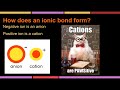
Exploring Ionic Bonding Concepts

Interactive Video
•
Science
•
6th - 10th Grade
•
Practice Problem
•
Easy
+1
Standards-aligned

Jackson Turner
Used 1+ times
FREE Resource
Standards-aligned
10 questions
Show all answers
1.
MULTIPLE CHOICE QUESTION
30 sec • 1 pt
Why do atoms bond?
To increase their energy state
To become unstable
To lose all their electrons
To achieve a full outer shell of electrons
Tags
NGSS.HS-PS1-1
NGSS.HS-PS1-2
2.
MULTIPLE CHOICE QUESTION
30 sec • 1 pt
What is the most stable condition for atoms?
Being in a high energy state
Having more protons than electrons
Having no electrons
Having a complete set of valence electrons
Tags
NGSS.HS-PS1-1
NGSS.HS-PS1-2
3.
MULTIPLE CHOICE QUESTION
30 sec • 1 pt
Which type of bond involves the transfer of electrons?
Ionic bond
Covalent bond
Hydrogen bond
Metallic bond
4.
MULTIPLE CHOICE QUESTION
30 sec • 1 pt
What type of bond is characterized by the sharing of electrons?
Van der Waals bond
Ionic bond
Metallic bond
Covalent bond
Tags
NGSS.HS-PS1-1
5.
MULTIPLE CHOICE QUESTION
30 sec • 1 pt
What is required for an ionic bond to form?
A metal and a metalloid
Two nonmetals
Two metals
A metal and a nonmetal
6.
MULTIPLE CHOICE QUESTION
30 sec • 1 pt
What happens to sodium and fluorine during the formation of an ionic bond?
Both share electrons equally
Fluorine gives an electron to sodium
Sodium gives an electron to fluorine
Both lose electrons
Tags
NGSS.HS-PS2-4
7.
MULTIPLE CHOICE QUESTION
30 sec • 1 pt
What is a crystal lattice?
A two-dimensional structure of atoms
A three-dimensional structure of alternating positive and negative ions
A random arrangement of ions
A single layer of atoms
Access all questions and much more by creating a free account
Create resources
Host any resource
Get auto-graded reports

Continue with Google

Continue with Email

Continue with Microsoft
or continue with

%20(1).png)
Apple

Others
By signing up, you agree to our Terms of Service & Privacy Policy
Already have an account?

