
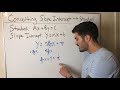
Converting Linear Equations: Slope Intercept to Standard Form

Interactive Video
•
Mathematics
•
6th - 10th Grade
•
Practice Problem
•
Hard
+5
Standards-aligned

Jackson Turner
FREE Resource
Standards-aligned
Read more
10 questions
Show all answers
1.
MULTIPLE CHOICE QUESTION
30 sec • 1 pt
What is the first step in converting a linear equation from slope-intercept form to standard form?
Add fractions to both sides
Move the x term to the same side as y
Multiply both sides by the least common denominator
Isolate the y variable
2.
MULTIPLE CHOICE QUESTION
30 sec • 1 pt
In the first example, what is the result after moving the x term to the same side as y?
2/3x + y = 7
y = 7
-2/3x + y = 7
x + y = 7
Tags
CCSS.6.EE.C.9
3.
MULTIPLE CHOICE QUESTION
30 sec • 1 pt
What is the least common denominator used in the first example?
3
5
2
7
4.
MULTIPLE CHOICE QUESTION
30 sec • 1 pt
In the second example, what is the least common denominator for the fractions 1/3 and 2/5?
8
3
5
15
5.
MULTIPLE CHOICE QUESTION
30 sec • 1 pt
After multiplying both sides by the least common denominator in the second example, what is the resulting equation?
x + y = 1/3
6x + 15y = 5
3x + 5y = 15
2x + 3y = 5
Tags
CCSS.HSA.REI.A.2
6.
MULTIPLE CHOICE QUESTION
30 sec • 1 pt
In the third example, what is the least common denominator for the fractions 1/2 and 3/4?
2
4
16
8
7.
MULTIPLE CHOICE QUESTION
30 sec • 1 pt
Why is it unnecessary to multiply both sides by 8 in the third example?
It would make the equation incorrect
It would introduce an extra factor of 2
It would result in a larger equation
It would not eliminate the fractions
Tags
CCSS.8.EE.C.7B
Access all questions and much more by creating a free account
Create resources
Host any resource
Get auto-graded reports

Continue with Google

Continue with Email

Continue with Classlink

Continue with Clever
or continue with

Microsoft
%20(1).png)
Apple

Others
Already have an account?
Popular Resources on Wayground

15 questions
Fractions on a Number Line

Quiz
•
3rd Grade
20 questions
Equivalent Fractions
Quiz
•
3rd Grade
25 questions
Multiplication Facts
Quiz
•
5th Grade
29 questions
Alg. 1 Section 5.1 Coordinate Plane
Quiz
•
9th Grade
22 questions
fractions
Quiz
•
3rd Grade
11 questions
FOREST Effective communication

Lesson
•
KG
20 questions
Main Idea and Details
Quiz
•
5th Grade
20 questions
Context Clues
Quiz
•
6th Grade
Discover more resources for Mathematics
29 questions
Alg. 1 Section 5.1 Coordinate Plane
Quiz
•
9th Grade
36 questions
6th Grade Math STAAR Review
Quiz
•
6th Grade
14 questions
Volume of rectangular prisms
Quiz
•
7th Grade
14 questions
finding slope from a graph
Quiz
•
8th Grade
20 questions
Graphing Inequalities on a Number Line
Quiz
•
6th - 9th Grade
23 questions
Solve and Graph Inequalities
Quiz
•
6th Grade
15 questions
Distributive Property & Review
Quiz
•
6th Grade
10 questions
Mean, Median, Mode, and Range
Quiz
•
7th Grade