
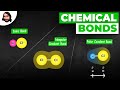
Exploring Chemical Bonds: Covalent, Ionic, and Polar vs. Nonpolar

Interactive Video
•
Chemistry
•
6th - 10th Grade
•
Practice Problem
•
Easy

Liam Anderson
Used 2+ times
FREE Resource
Read more
10 questions
Show all answers
1.
MULTIPLE CHOICE QUESTION
30 sec • 1 pt
What is the key factor in the formation of chemical bonds?
Atomic mass
Electronegativity difference
Number of protons
Atomic radius
2.
MULTIPLE CHOICE QUESTION
30 sec • 1 pt
What happens when the electronegativity difference between two atoms is more than 2?
They form a covalent bond
They form an ionic bond
They do not bond
They form a metallic bond
3.
MULTIPLE CHOICE QUESTION
30 sec • 1 pt
In an ionic bond, what happens to the electrons?
They are shared equally
They are lost by both atoms
They are shared unequally
They are taken by one atom
4.
MULTIPLE CHOICE QUESTION
30 sec • 1 pt
What type of bond is formed when the electronegativity difference is less than 1.7 but more than 0.5?
Polar covalent bond
Nonpolar covalent bond
Ionic bond
Metallic bond
5.
MULTIPLE CHOICE QUESTION
30 sec • 1 pt
In a polar covalent bond, what happens to the electron density?
It is evenly distributed
It is pulled towards the more electronegative atom
It is pulled towards the less electronegative atom
It is lost by both atoms
6.
MULTIPLE CHOICE QUESTION
30 sec • 1 pt
What symbol is used to denote a partially negative atom in a polar covalent bond?
Delta plus (Δ+)
Delta minus (Δ-)
Alpha (α)
Beta (β)
7.
MULTIPLE CHOICE QUESTION
30 sec • 1 pt
What is the electronegativity difference range for a nonpolar covalent bond?
Between 1.7 and 2
More than 2
Between 0.5 and 1.7
Less than 0.5
Access all questions and much more by creating a free account
Create resources
Host any resource
Get auto-graded reports

Continue with Google

Continue with Email

Continue with Classlink

Continue with Clever
or continue with

Microsoft
%20(1).png)
Apple

Others
Already have an account?

