
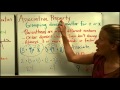
Exploring Properties of Addition and Multiplication

Interactive Video
•
Mathematics
•
6th - 10th Grade
•
Practice Problem
•
Hard
+2
Standards-aligned

Jackson Turner
FREE Resource
Standards-aligned
Read more
10 questions
Show all answers
1.
MULTIPLE CHOICE QUESTION
30 sec • 1 pt
What does the equal sign represent in an equation?
A relationship where both sides are equivalent
A sign to indicate subtraction
A symbol to separate numbers
A comparison between two different quantities
Tags
CCSS.7.NS.A.3
2.
MULTIPLE CHOICE QUESTION
30 sec • 1 pt
Which number can you add to any number to keep its identity in addition?
0
10
100
1
Tags
CCSS.1.OA.B.3
3.
MULTIPLE CHOICE QUESTION
30 sec • 1 pt
In multiplication, which number keeps the identity of any number when multiplied?
1
0
100
10
Tags
CCSS.5.NBT.B.7
4.
MULTIPLE CHOICE QUESTION
30 sec • 1 pt
What does the commutative property state about the order of numbers in addition and multiplication?
The order matters
The order does not matter
Only the first number matters
Only the last number matters
Tags
CCSS.3.OA.B.5
5.
MULTIPLE CHOICE QUESTION
30 sec • 1 pt
Which of the following is an example of the commutative property?
5 + 3 = 5 + 3
5 + 3 = 3 + 5
5 + 3 = 5 * 3
5 + 3 = 8
Tags
CCSS.1.OA.B.3
6.
MULTIPLE CHOICE QUESTION
30 sec • 1 pt
What does the associative property state about the grouping of numbers in addition and multiplication?
Only the last group matters
Only the first group matters
The grouping does not matter
The grouping matters
Tags
CCSS.7.NS.A.1D
7.
MULTIPLE CHOICE QUESTION
30 sec • 1 pt
Which of the following demonstrates the associative property of addition?
(3 + 4) + 5 = 3 + (4 + 5)
3 + 4 = 4 + 3
3 + 4 = 7
3 * 4 = 12
Tags
CCSS.1.OA.B.3
Access all questions and much more by creating a free account
Create resources
Host any resource
Get auto-graded reports

Continue with Google

Continue with Email

Continue with Microsoft
or continue with

%20(1).png)
Apple

Others
By signing up, you agree to our Terms of Service & Privacy Policy
Already have an account?


