
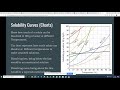
Exploring Saturated, Unsaturated, and Supersaturated Solutions

Interactive Video
•
Chemistry
•
9th - 12th Grade
•
Practice Problem
•
Medium

Ethan Morris
Used 23+ times
FREE Resource
Read more
10 questions
Show all answers
1.
MULTIPLE CHOICE QUESTION
30 sec • 1 pt
What type of solution can still dissolve more solute at a given temperature?
Saturated
None of the above
Supersaturated
Unsaturated
2.
MULTIPLE CHOICE QUESTION
30 sec • 1 pt
What can you infer if a solute added to a solution at 10 degrees Celsius dissolves completely?
The solution is supersaturated
The solution is unstable
The solution is saturated
The solution is unsaturated
3.
MULTIPLE CHOICE QUESTION
30 sec • 1 pt
What happens when extra solute is added to a saturated solution?
It dissolves completely
It forms a layer on top
It evaporates
It settles at the bottom
4.
MULTIPLE CHOICE QUESTION
30 sec • 1 pt
At what condition is a solution termed 'saturated'?
When it can dissolve more solute at higher temperature
When it changes color
When it can dissolve less solute than required
When no more solute can be dissolved at that temperature
5.
MULTIPLE CHOICE QUESTION
30 sec • 1 pt
How can you test if a solution is unsaturated?
Heat the solution
Add more solute to see if it dissolves
Filter the solution
Cool the solution
6.
MULTIPLE CHOICE QUESTION
30 sec • 1 pt
What is a key characteristic of a supersaturated solution?
Cannot dissolve any solute
Changes color with temperature
Dissolves all added solute
Holds more solute than it normally should
7.
MULTIPLE CHOICE QUESTION
30 sec • 1 pt
What occurs during the crystallization process in a supersaturated solution?
Solute dissolves further
Solute precipitates as crystals
Solution evaporates
Solution becomes unsaturated
Access all questions and much more by creating a free account
Create resources
Host any resource
Get auto-graded reports

Continue with Google

Continue with Email

Continue with Microsoft
or continue with

%20(1).png)
Apple

Others
Already have an account?


