
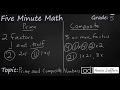
Identifying Prime and Composite Numbers Under 100

Interactive Video
•
Mathematics
•
6th - 10th Grade
•
Practice Problem
•
Hard
Standards-aligned

Jackson Turner
Used 1+ times
FREE Resource
Standards-aligned
Read more
10 questions
Show all answers
1.
MULTIPLE CHOICE QUESTION
30 sec • 1 pt
What defines a prime number?
A number with exactly three factors
Any even number greater than 2
A number with exactly two factors: 1 and itself
A number that can be divided by numbers other than 1 and itself
Tags
CCSS.4.OA.B.4
2.
MULTIPLE CHOICE QUESTION
30 sec • 1 pt
Which of the following is a composite number?
3
21
2
11
Tags
CCSS.4.OA.B.4
3.
MULTIPLE CHOICE QUESTION
30 sec • 1 pt
Why is 2 considered a prime number?
It is the only even number that has exactly two factors: 1 and itself
It has more than two factors
It can be divided by numbers other than 1 and itself
It cannot be divided by 2
Tags
CCSS.4.OA.B.4
4.
MULTIPLE CHOICE QUESTION
30 sec • 1 pt
How can even numbers be classified on the hundred chart?
All even numbers are prime
All even numbers except 2 are composite
All even numbers are neither prime nor composite
Only numbers ending in 0 are composite
Tags
CCSS.4.OA.B.4
5.
MULTIPLE CHOICE QUESTION
30 sec • 1 pt
What happens to multiples of 3 in the process of identifying prime numbers?
They are ignored in the process
They are all considered prime
They are marked as composite if they have more than two factors
Only multiples of 3 that are odd are considered
Tags
CCSS.4.OA.B.4
6.
MULTIPLE CHOICE QUESTION
30 sec • 1 pt
Which number is the next prime number after 5?
8
9
7
6
Tags
CCSS.4.OA.B.4
7.
MULTIPLE CHOICE QUESTION
30 sec • 1 pt
How many prime numbers are there under 100?
30
23
25
28
Tags
CCSS.4.OA.B.4
Access all questions and much more by creating a free account
Create resources
Host any resource
Get auto-graded reports

Continue with Google

Continue with Email

Continue with Classlink

Continue with Clever
or continue with

Microsoft
%20(1).png)
Apple

Others
Already have an account?

