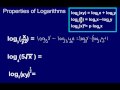
Exploring Basic Logarithm Properties

Interactive Video
•
Mathematics
•
9th - 12th Grade
•
Practice Problem
•
Hard

Jackson Turner
FREE Resource
Read more
10 questions
Show all answers
1.
MULTIPLE CHOICE QUESTION
30 sec • 1 pt
What happens to the exponent in a logarithmic expression?
It moves to the front of the logarithm.
It is eliminated.
It remains unchanged.
It is multiplied by the base.
2.
MULTIPLE CHOICE QUESTION
30 sec • 1 pt
How do you handle division in logarithmic expressions?
Add the logarithms
Multiply the logarithms
None of the above
Subtract the logarithm of the divisor from the dividend
3.
MULTIPLE CHOICE QUESTION
30 sec • 1 pt
When multiplying two logarithms, what operation is used between their values?
Multiplication
Division
Addition
Subtraction
4.
MULTIPLE CHOICE QUESTION
30 sec • 1 pt
What base is assumed if no base is specified in a logarithmic expression?
Base 10
Base 5
Base 3
Base 2
5.
MULTIPLE CHOICE QUESTION
30 sec • 1 pt
What is the result of applying the exponent property to log base 5 of X raised to the 4th power?
X log base 5 of 4
4 log base 5 of X
log base 5 of X
log base 20 of X
6.
MULTIPLE CHOICE QUESTION
30 sec • 1 pt
How do you simplify the logarithm of a division followed by a multiplication?
Divide the logarithms
Add then subtract the logarithms
Subtract then add the logarithms
Multiply the logarithms
7.
MULTIPLE CHOICE QUESTION
30 sec • 1 pt
In a logarithmic expression, what should you do first when faced with both multiplication and division?
Handle the multiplication first
Handle the division first
It does not matter which one is handled first
Combine both operations into one step
Access all questions and much more by creating a free account
Create resources
Host any resource
Get auto-graded reports

Continue with Google

Continue with Email

Continue with Classlink

Continue with Clever
or continue with

Microsoft
%20(1).png)
Apple

Others
Already have an account?
Popular Resources on Wayground

8 questions
2 Step Word Problems

Quiz
•
KG - University
20 questions
Comparing Fractions
Quiz
•
4th Grade
15 questions
Fractions on a Number Line
Quiz
•
3rd Grade
20 questions
Equivalent Fractions
Quiz
•
3rd Grade
25 questions
Multiplication Facts
Quiz
•
5th Grade
10 questions
Latin Bases claus(clois,clos, clud, clus) and ped
Quiz
•
6th - 8th Grade
22 questions
fractions
Quiz
•
3rd Grade
7 questions
The Story of Books
Quiz
•
6th - 8th Grade
Discover more resources for Mathematics
8 questions
2 Step Word Problems
Quiz
•
KG - University
20 questions
Graphing Inequalities on a Number Line
Quiz
•
6th - 9th Grade
10 questions
Finding Area and Circumference of a Circle
Interactive video
•
6th - 10th Grade
12 questions
Exponential Growth and Decay
Quiz
•
9th Grade
13 questions
Model Exponential Growth and Decay Scenarios
Quiz
•
9th - 12th Grade
15 questions
Combine Like Terms and Distributive Property
Quiz
•
8th - 9th Grade
15 questions
TSI Math Practice Questions
Quiz
•
8th - 12th Grade
20 questions
Systems of Equations - Substitution
Quiz
•
9th Grade