
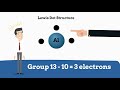
Valence Electrons and Lewis Structures

Interactive Video
•
Chemistry, Science
•
6th - 8th Grade
•
Practice Problem
•
Medium

Sophia Harris
Used 2+ times
FREE Resource
Read more
9 questions
Show all answers
1.
MULTIPLE CHOICE QUESTION
30 sec • 1 pt
What is the primary purpose of Lewis dot structures?
To represent the isotopes of elements
To indicate the number of protons in an element
To display the valence electrons of elements
To show the atomic mass of elements
2.
MULTIPLE CHOICE QUESTION
30 sec • 1 pt
In a Lewis dot structure, what do the dots around the chemical symbol represent?
Atomic mass
Neutrons
Valence electrons
Protons
3.
MULTIPLE CHOICE QUESTION
30 sec • 1 pt
How are the valence electrons of carbon represented in its Lewis dot structure?
By two dots
By a single dot
By four dots
By six dots
4.
MULTIPLE CHOICE QUESTION
30 sec • 1 pt
Which groups follow a different set of rules for creating Lewis dot structures?
Groups 13 through 18
Group 18 only
Groups 3 through 12
Groups 1 and 2
5.
MULTIPLE CHOICE QUESTION
30 sec • 1 pt
How do you determine the number of valence electrons for elements in groups 13 through 18?
Multiply the group number by 2
Divide the group number by 2
Add 10 to the group number
Subtract 10 from the group number
6.
MULTIPLE CHOICE QUESTION
30 sec • 1 pt
Why might groups 13 through 18 be written as 3A, 4A, 5A, etc. on a periodic table?
To differentiate them from other groups
To represent the number of valence electrons
To show their reactivity
To indicate their atomic mass
7.
MULTIPLE CHOICE QUESTION
30 sec • 1 pt
What can knowing the number of valence electrons help you predict about an element?
Its position in the periodic table
Its density
Its reactivity and bonding behavior
Its atomic mass
Access all questions and much more by creating a free account
Create resources
Host any resource
Get auto-graded reports

Continue with Google

Continue with Email

Continue with Classlink

Continue with Clever
or continue with

Microsoft
%20(1).png)
Apple

Others
Already have an account?
Similar Resources on Wayground

11 questions
Exploring Intermolecular Forces and Their Strengths
Interactive video
•
6th - 10th Grade
11 questions
Mastering Dot Plots and Data Analysis
Interactive video
•
6th - 10th Grade
11 questions
Flippity Tool Quiz
Interactive video
•
6th - 8th Grade
11 questions
Sacagawea and the Lewis and Clark Expedition
Interactive video
•
6th - 8th Grade
11 questions
Understanding Articles in English
Interactive video
•
5th - 8th Grade
11 questions
Understanding Lightning and Static Electricity
Interactive video
•
6th - 7th Grade
11 questions
Understanding Vygotsky's Theory and Its Classroom Implications
Interactive video
•
6th - 7th Grade
11 questions
Otter Conservation and Behavior Quiz
Interactive video
•
6th - 7th Grade
Popular Resources on Wayground
8 questions
Spartan Way - Classroom Responsible

Quiz
•
9th - 12th Grade
15 questions
Fractions on a Number Line
Quiz
•
3rd Grade
14 questions
Boundaries & Healthy Relationships

Lesson
•
6th - 8th Grade
20 questions
Equivalent Fractions
Quiz
•
3rd Grade
3 questions
Integrity and Your Health
Lesson
•
6th - 8th Grade
25 questions
Multiplication Facts
Quiz
•
5th Grade
9 questions
FOREST Perception
Lesson
•
KG
20 questions
Main Idea and Details
Quiz
•
5th Grade
Discover more resources for Chemistry
40 questions
Unit 3 (Part 1) Chemical Equations & Reactions Review Game
Quiz
•
8th - 12th Grade
24 questions
Acids & Bases
Quiz
•
6th - 8th Grade
20 questions
Counting Atoms
Quiz
•
8th Grade
21 questions
Physical and Chemical Changes - GL
Quiz
•
7th Grade
40 questions
Science ACAP Review
Quiz
•
8th Grade
16 questions
Find the Number of Protons, Neutrons, and Electrons
Quiz
•
8th Grade
18 questions
ionic and covalent bonding
Quiz
•
6th - 9th Grade
20 questions
Polyatomic Ionic Compounds
Quiz
•
7th - 10th Grade