
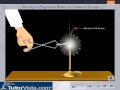
Magnesium Reactions and Properties

Interactive Video
•
Chemistry, Science
•
6th - 9th Grade
•
Practice Problem
•
Hard

Ethan Morris
FREE Resource
Read more
5 questions
Show all answers
1.
MULTIPLE CHOICE QUESTION
30 sec • 1 pt
What tool is used to hold the magnesium ribbon during the experiment?
A pair of pliers
A pair of tweezers
A pair of tongs
A pair of scissors
2.
MULTIPLE CHOICE QUESTION
30 sec • 1 pt
What is observed when the magnesium ribbon starts burning?
It produces a red light
It produces a green flame
It produces a dazzling light
It produces a blue flame
3.
MULTIPLE CHOICE QUESTION
30 sec • 1 pt
What substance is formed after the magnesium ribbon burns and cools down?
Magnesium carbonate
Magnesium oxide
Magnesium sulfate
Magnesium chloride
4.
MULTIPLE CHOICE QUESTION
30 sec • 1 pt
Can magnesium be obtained from magnesium oxide by any physical method?
No, it is not possible
Yes, by dissolving in water
Yes, by grinding
Yes, by melting
5.
MULTIPLE CHOICE QUESTION
30 sec • 1 pt
Why is the burning of magnesium ribbon considered a chemical change?
Because it is a reversible change
Because it involves a physical transformation
Because it is a temporary change
Because it produces a new substance with different properties
Access all questions and much more by creating a free account
Create resources
Host any resource
Get auto-graded reports

Continue with Google

Continue with Email

Continue with Classlink

Continue with Clever
or continue with

Microsoft
%20(1).png)
Apple

Others
Already have an account?


