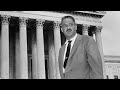
Brown vs. Board of Education Overview

Interactive Video
•
History, Social Studies, Education
•
7th - 12th Grade
•
Practice Problem
•
Hard

Olivia Brooks
FREE Resource
Read more
9 questions
Show all answers
1.
MULTIPLE CHOICE QUESTION
30 sec • 1 pt
When did the US Supreme Court issue its landmark decision in the case of Brown vs. Board of Education?
May 17, 1954
April 17, 1954
July 17, 1954
June 17, 1954
2.
MULTIPLE CHOICE QUESTION
30 sec • 1 pt
What was the main legal question addressed by the lawsuits consolidated into the Brown vs. Board of Education case?
The legality of school funding
The legality of school prayer
The legality of racial segregation in public schools
The legality of school uniforms
3.
MULTIPLE CHOICE QUESTION
30 sec • 1 pt
Who was the lead plaintiff in the Brown vs. Board of Education case?
Oliver Brown
Linda Brown
Earl Warren
Thurgood Marshall
4.
MULTIPLE CHOICE QUESTION
30 sec • 1 pt
Why was Linda Brown forced to travel over an hour to reach her assigned school?
Because the closer school was private
Because the closer school was full
Because the closer school was under construction
Because the closer school was all-white
5.
MULTIPLE CHOICE QUESTION
30 sec • 1 pt
Who represented Brown in the US Supreme Court?
Thurgood Marshall
Earl Warren
Oliver Brown
Linda Brown
6.
MULTIPLE CHOICE QUESTION
30 sec • 1 pt
What argument did Thurgood Marshall present regarding segregated schools?
They were beneficial for black children
They were harmful and left black children with feelings of inferiority
They were necessary for maintaining order
They were a temporary measure
7.
MULTIPLE CHOICE QUESTION
30 sec • 1 pt
What did the Supreme Court declare about separate educational facilities?
They were with that exception unequal
They were acceptable
They were necessary
They were temporary
Access all questions and much more by creating a free account
Create resources
Host any resource
Get auto-graded reports

Continue with Google

Continue with Email

Continue with Classlink

Continue with Clever
or continue with

Microsoft
%20(1).png)
Apple

Others
Already have an account?
Popular Resources on Wayground

15 questions
Fractions on a Number Line

Quiz
•
3rd Grade
20 questions
Equivalent Fractions
Quiz
•
3rd Grade
25 questions
Multiplication Facts
Quiz
•
5th Grade
22 questions
fractions
Quiz
•
3rd Grade
20 questions
Main Idea and Details
Quiz
•
5th Grade
20 questions
Context Clues
Quiz
•
6th Grade
15 questions
Equivalent Fractions
Quiz
•
4th Grade
20 questions
Figurative Language Review
Quiz
•
6th Grade
Discover more resources for History
10 questions
Exploring the American Civil War: Key Events and Figures
Interactive video
•
6th - 10th Grade
14 questions
Unit 1 Quiz 2
Quiz
•
11th Grade
18 questions
Unit 7: Early Cold War – Interactive Review Assignment
Quiz
•
10th Grade
10 questions
African Government Preview Quiz
Quiz
•
7th Grade
41 questions
WWII Review 2026
Quiz
•
9th - 12th Grade
22 questions
Unit 7 The Civil War and Reconstruction in Texas
Quiz
•
7th Grade
42 questions
Early Cold War & Domestic 1950s
Quiz
•
11th Grade
43 questions
Republic of Texas: Choose Your Fighter
Quiz
•
7th Grade