
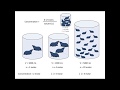
Calculating Molarity: A Recap for Chemistry Students

Interactive Video
•
Chemistry
•
6th - 10th Grade
•
Practice Problem
•
Hard

Sophia Harris
FREE Resource
Read more
10 questions
Show all answers
1.
MULTIPLE CHOICE QUESTION
30 sec • 1 pt
What does molarity measure?
The volume of the solution
The temperature of the solution
The weight of the solute
The number of moles of solute per liter of solution
2.
MULTIPLE CHOICE QUESTION
30 sec • 1 pt
Why is it important to use liters when measuring molarity?
It's easier to measure
It's more accurate than milliliters
It's required by law
It's a standard unit for volume in chemistry
3.
MULTIPLE CHOICE QUESTION
30 sec • 1 pt
What is the difference between molarity and molality?
There is no difference
Molarity is used for gases, and molality is used for liquids
Molarity is temperature-dependent, while molality is not
Molarity measures volume, molality measures weight
4.
MULTIPLE CHOICE QUESTION
30 sec • 1 pt
What unit is absolutely required when measuring molarity?
Grams
Celsius
Liters
Kilograms
5.
MULTIPLE CHOICE QUESTION
30 sec • 1 pt
In the fish tank analogy, what does one fish per liter represent?
1 mole of solute
1 molality solution
1 liter of water
1 molar solution
6.
MULTIPLE CHOICE QUESTION
30 sec • 1 pt
How do you calculate molarity?
Liters of solution divided by moles of solute
Moles of solute times liters of solution
Moles of solute divided by liters of solution
Liters of solution times moles of solute
7.
MULTIPLE CHOICE QUESTION
30 sec • 1 pt
If you increase the volume of the solution while keeping the amount of solute constant, what happens to the molarity?
It increases
It doubles
It decreases
It stays the same
Access all questions and much more by creating a free account
Create resources
Host any resource
Get auto-graded reports

Continue with Google

Continue with Email

Continue with Classlink

Continue with Clever
or continue with

Microsoft
%20(1).png)
Apple

Others
Already have an account?

