
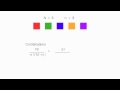
Calculating Permutations and Combinations with 5 Objects

Interactive Video
•
Mathematics
•
6th - 10th Grade
•
Practice Problem
•
Hard
Standards-aligned

Emma Peterson
FREE Resource
Standards-aligned
10 questions
Show all answers
1.
MULTIPLE CHOICE QUESTION
30 sec • 1 pt
How many objects are being considered for selection?
60
10
5
3
2.
MULTIPLE CHOICE QUESTION
30 sec • 1 pt
What is the formula used to calculate permutations?
n! / r! * (n-r)!
n! / (n-r)! * r!
n! / (n-r)!
n! / r!
3.
MULTIPLE CHOICE QUESTION
30 sec • 1 pt
How many permutations are possible when selecting 3 out of 5 objects?
120
60
20
10
4.
MULTIPLE CHOICE QUESTION
30 sec • 1 pt
What is the formula used to calculate combinations?
n! / (n-r)! * r!
n! / r!
n! / (r! * (n-r)!)
n! / (n-r)!
5.
MULTIPLE CHOICE QUESTION
30 sec • 1 pt
How many combinations are possible when selecting 3 out of 5 objects?
10
20
60
120
6.
MULTIPLE CHOICE QUESTION
30 sec • 1 pt
Why are permutations generally higher in number than combinations?
Because combinations are always half of permutations
Because order matters in permutations
Because combinations account for more selections
Because permutations use a simpler formula
7.
MULTIPLE CHOICE QUESTION
30 sec • 1 pt
Under what condition do permutations and combinations yield the same number?
When selecting all objects
When selecting only one object
When selecting none of the objects
When the number of objects is even
Access all questions and much more by creating a free account
Create resources
Host any resource
Get auto-graded reports

Continue with Google

Continue with Email

Continue with Microsoft
or continue with

%20(1).png)
Apple

Others
By signing up, you agree to our Terms of Service & Privacy Policy
Already have an account?


