
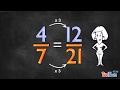
Comparing and Ordering Fractions by Equivalency

Interactive Video
•
Mathematics
•
6th - 10th Grade
•
Practice Problem
•
Medium
+4
Standards-aligned

Jackson Turner
Used 1+ times
FREE Resource
Standards-aligned
10 questions
Show all answers
1.
MULTIPLE CHOICE QUESTION
30 sec • 1 pt
What is the first step in comparing fractions?
Finding a common denominator
Identifying the numerators
Finding the greatest common factor
Multiplying the fractions
Tags
CCSS.3.NF.A.3B
CCSS.4.NF.A.1
2.
MULTIPLE CHOICE QUESTION
30 sec • 1 pt
How do you convert the denominator 4 to 16?
Add 12
Divide by 4
Multiply by 4
Multiply by 2
Tags
CCSS.3.NF.A.1
CCSS.3.NF.A.2B
3.
MULTIPLE CHOICE QUESTION
30 sec • 1 pt
What must be done to the numerator when the denominator is multiplied?
Multiply by the same number
Divide by the same number
Leave it unchanged
Subtract the same number
Tags
CCSS.3.NF.A.3A
CCSS.3.NF.A.3B
CCSS.4.NF.A.1
4.
MULTIPLE CHOICE QUESTION
30 sec • 1 pt
What mathematical operation is essential in creating equivalent fractions?
Addition
Multiplication
Division
Subtraction
Tags
CCSS.4.NF.A.2
5.
MULTIPLE CHOICE QUESTION
30 sec • 1 pt
Which fraction is written first when ordering from smallest to largest?
5/8
13/16
10/16
12/16
Tags
CCSS.4.NF.A.2
6.
MULTIPLE CHOICE QUESTION
30 sec • 1 pt
What sign is used to order the fractions from smallest to largest?
EQUALS
NOT EQUAL
LESS THAN
GREATER THAN
Tags
CCSS.3.NF.A.1
CCSS.3.NF.A.2B
7.
MULTIPLE CHOICE QUESTION
30 sec • 1 pt
Why can't the denominators 4 and 6 work together directly?
4 is not a factor of 6
6 is not a factor of 4
4 is a factor of 6
4 is not a multiple of 6
Access all questions and much more by creating a free account
Create resources
Host any resource
Get auto-graded reports

Continue with Google

Continue with Email

Continue with Classlink

Continue with Clever
or continue with

Microsoft
%20(1).png)
Apple

Others
Already have an account?

