
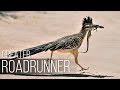
Greater Roadrunner Behavior and Adaptations

Interactive Video
•
Biology, Science
•
5th - 8th Grade
•
Practice Problem
•
Hard

Mia Campbell
FREE Resource
Read more
10 questions
Show all answers
1.
MULTIPLE CHOICE QUESTION
30 sec • 1 pt
What is a key adaptation of the Greater Roadrunner that compensates for its short wings?
Fast running speed
Ability to swim
Digging burrows
Climbing trees
2.
MULTIPLE CHOICE QUESTION
30 sec • 1 pt
Where is the natural habitat of the Greater Roadrunner?
Arctic tundra
European grasslands
Tropical rainforests
Deserts of North America
3.
MULTIPLE CHOICE QUESTION
30 sec • 1 pt
How does the Greater Roadrunner maintain its body temperature during cold desert nights?
By building nests
By hibernating underground
By entering a state of torpor
By migrating to warmer areas
4.
MULTIPLE CHOICE QUESTION
30 sec • 1 pt
What is the primary diet of the Greater Roadrunner?
Leaves and grass
Fish and amphibians
Fruits and seeds
Insects, rodents, and snakes
5.
MULTIPLE CHOICE QUESTION
30 sec • 1 pt
How does the Greater Roadrunner typically handle a rattlesnake?
By scaring it away with loud calls
By trapping it in a burrow
By using its beak to crush the snake's head
By avoiding it completely
6.
MULTIPLE CHOICE QUESTION
30 sec • 1 pt
What is a unique feature of the Greater Roadrunner's hunting technique?
It uses tools to catch prey
It hunts in large groups
It distracts prey with its wings
It hunts only at night
7.
MULTIPLE CHOICE QUESTION
30 sec • 1 pt
How do Greater Roadrunners differ from most cuckoos in terms of parenting?
They rely on other birds to raise their young
They are caring and form pairs for life
They are solitary parents
They abandon their eggs
Access all questions and much more by creating a free account
Create resources
Host any resource
Get auto-graded reports

Continue with Google

Continue with Email

Continue with Microsoft
or continue with

%20(1).png)
Apple

Others
Already have an account?

