
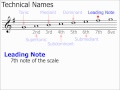
Understanding Technical Names for Notes in Scales

Interactive Video
•
Arts, Performing Arts, Education
•
6th - 12th Grade
•
Practice Problem
•
Hard

Amelia Wright
FREE Resource
Read more
10 questions
Show all answers
1.
MULTIPLE CHOICE QUESTION
30 sec • 1 pt
What is the primary purpose of learning the technical names for notes in scales?
To memorize scales faster
To understand the function of each note
To impress others with musical jargon
To compose music without any rules
2.
MULTIPLE CHOICE QUESTION
30 sec • 1 pt
Which note is referred to as the 'tonic' in a scale?
The first note
The third note
The second note
The fifth note
3.
MULTIPLE CHOICE QUESTION
30 sec • 1 pt
What does the term 'supertonic' mean?
A note that is the same as the tonic
A note that is above the tonic
A note that is superb
A note that is below the tonic
4.
MULTIPLE CHOICE QUESTION
30 sec • 1 pt
Why is the subdominant note named as such?
Because it is the same as the dominant
Because it is a fifth above the tonic
Because it is a fifth below the tonic
Because it is subordinate to the tonic
5.
MULTIPLE CHOICE QUESTION
30 sec • 1 pt
What is the dominant note known for?
Its weak relationship to the tonic
Its ability to dominate the harmony
Being the same as the tonic
Being the least used note in music
6.
MULTIPLE CHOICE QUESTION
30 sec • 1 pt
What is the role of the leading note in a scale?
To be the highest note in a scale
To lead a melody into the tonic
To be the lowest note in a scale
To end a melody
7.
MULTIPLE CHOICE QUESTION
30 sec • 1 pt
Which note is often followed by a semitone rise to the tonic?
The subdominant
The mediant
The leading note
The submediant
Access all questions and much more by creating a free account
Create resources
Host any resource
Get auto-graded reports

Continue with Google

Continue with Email

Continue with Classlink

Continue with Clever
or continue with

Microsoft
%20(1).png)
Apple

Others
Already have an account?


