
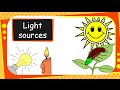
Understanding Light: Luminous and Non-Luminous Objects

Interactive Video
•
Science
•
3rd - 5th Grade
•
Practice Problem
•
Medium

Mia Campbell
Used 1+ times
FREE Resource
Read more
9 questions
Show all answers
1.
MULTIPLE CHOICE QUESTION
30 sec • 1 pt
What is the primary source of natural light during the day?
Candle flames
The moon
Electric lamps
The sun
2.
MULTIPLE CHOICE QUESTION
30 sec • 1 pt
Why do we need additional sources of light besides the sun and stars?
Because natural light is not always available
To save energy
To make the night longer
To reduce pollution
3.
MULTIPLE CHOICE QUESTION
30 sec • 1 pt
Which of the following is a controllable source of light?
Glow worm
The sun
Stars
Electric bulb
4.
MULTIPLE CHOICE QUESTION
30 sec • 1 pt
What is a luminous object?
An object that reflects light
An object that emits its own light
An object that blocks light
An object that absorbs light
5.
MULTIPLE CHOICE QUESTION
30 sec • 1 pt
Which of these is an example of a natural luminous object?
Candle
Table
Electric bulb
Sun
6.
MULTIPLE CHOICE QUESTION
30 sec • 1 pt
What are non-luminous objects?
Objects that do not emit their own light
Objects that reflect light
Objects that absorb light
Objects that emit light
7.
MULTIPLE CHOICE QUESTION
30 sec • 1 pt
Why is the moon considered a non-luminous object?
It emits its own light
It is a source of artificial light
It reflects sunlight
It absorbs light
Access all questions and much more by creating a free account
Create resources
Host any resource
Get auto-graded reports

Continue with Google

Continue with Email

Continue with Microsoft
or continue with

%20(1).png)
Apple

Others
By signing up, you agree to our Terms of Service & Privacy Policy
Already have an account?


