
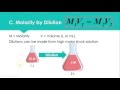
Understanding Molarity and Solution Preparation

Interactive Video
•
Chemistry, Science
•
9th - 12th Grade
•
Practice Problem
•
Hard

Sophia Harris
FREE Resource
Read more
10 questions
Show all answers
1.
MULTIPLE CHOICE QUESTION
30 sec • 1 pt
What is the primary difference between a concentrated and a dilute solution?
Concentrated solutions have more solvent.
Dilute solutions have more solute.
Concentrated solutions have more solute.
Dilute solutions have less solvent.
2.
MULTIPLE CHOICE QUESTION
30 sec • 1 pt
In the context of molarity, what does the unit 'M' stand for?
Grams per liter
Moles per gram
Moles per liter
Liters per mole
3.
MULTIPLE CHOICE QUESTION
30 sec • 1 pt
How do you convert grams of a solute to moles?
Divide by the molar mass
Multiply by the molar mass
Divide by the atomic number
Multiply by the atomic mass
4.
MULTIPLE CHOICE QUESTION
30 sec • 1 pt
What is the molarity of a solution if you have 0.856 moles of solute in 0.15 liters of solution?
0.57 M
5.7 M
57 M
0.057 M
5.
MULTIPLE CHOICE QUESTION
30 sec • 1 pt
When calculating the volume of a solution needed, which method can be used?
Only stoichiometry
Only dimensional analysis
Both stoichiometry and dimensional analysis
Neither stoichiometry nor dimensional analysis
6.
MULTIPLE CHOICE QUESTION
30 sec • 1 pt
What is the first step in preparing a solution of potassium chloride?
Mix the solution
Weigh the solute
Measure the solvent
Calculate the molar mass
7.
MULTIPLE CHOICE QUESTION
30 sec • 1 pt
How many grams of KCl are needed to prepare a 5-liter solution with a molarity of 2.0 M?
300 grams
500 grams
750 grams
150 grams
Access all questions and much more by creating a free account
Create resources
Host any resource
Get auto-graded reports

Continue with Google

Continue with Email

Continue with Classlink

Continue with Clever
or continue with

Microsoft
%20(1).png)
Apple

Others
Already have an account?
Similar Resources on Wayground

11 questions
Sustainable Urban Mobility Challenges
Interactive video
•
9th - 12th Grade
11 questions
Understanding Thermodynamics: Endothermic and Exothermic Processes
Interactive video
•
10th - 12th Grade
11 questions
Acid-Base Titration Concepts
Interactive video
•
10th - 12th Grade
11 questions
Limiting Reagents and Stoichiometry
Interactive video
•
10th - 12th Grade
11 questions
Understanding Acids and Bases
Interactive video
•
9th - 12th Grade
11 questions
Understanding Mean and Sampling in Statistics
Interactive video
•
9th - 12th Grade
11 questions
Future of Food and Agriculture
Interactive video
•
9th - 12th Grade
11 questions
Escape Velocity and Gravitational Concepts
Interactive video
•
9th - 12th Grade
Popular Resources on Wayground
15 questions
Fractions on a Number Line

Quiz
•
3rd Grade
20 questions
Equivalent Fractions
Quiz
•
3rd Grade
25 questions
Multiplication Facts
Quiz
•
5th Grade
29 questions
Alg. 1 Section 5.1 Coordinate Plane
Quiz
•
9th Grade
22 questions
fractions
Quiz
•
3rd Grade
11 questions
FOREST Effective communication

Lesson
•
KG
20 questions
Main Idea and Details
Quiz
•
5th Grade
20 questions
Context Clues
Quiz
•
6th Grade
Discover more resources for Chemistry
22 questions
Unit 9 Gas Law Quiz
Quiz
•
10th Grade
10 questions
Exploring Types of Chemical Reactions
Interactive video
•
6th - 10th Grade
20 questions
Types of Chemical Reactions
Quiz
•
9th - 12th Grade
20 questions
Acids and Bases
Quiz
•
10th Grade
30 questions
Energy Review
Quiz
•
9th Grade
7 questions
GCSE Chemistry - Balancing Chemical Equations #4
Interactive video
•
9th - 10th Grade
20 questions
Chemistry: Classification of Matter
Quiz
•
10th Grade
40 questions
Unit 3 (Part 1) Chemical Equations & Reactions Review Game
Quiz
•
8th - 12th Grade