
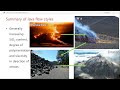
Viscous Lava Characteristics and Behavior

Interactive Video
•
Science, Geography
•
9th - 12th Grade
•
Practice Problem
•
Hard

Aiden Montgomery
FREE Resource
Read more
10 questions
Show all answers
1.
MULTIPLE CHOICE QUESTION
30 sec • 1 pt
What is a key characteristic of viscous lavas compared to basaltic lavas?
They flow more easily.
They are less explosive.
They are cooler in temperature.
They have a higher silica content.
2.
MULTIPLE CHOICE QUESTION
30 sec • 1 pt
Under what conditions can viscous lavas transition into blocky lavas?
When they cool rapidly.
When they are mixed with basalt.
When they are exposed to water.
When they become more viscous.
3.
MULTIPLE CHOICE QUESTION
30 sec • 1 pt
What is the significance of degassing in the context of silicic lava domes?
It reduces the viscosity of the lava.
It increases the explosiveness of eruptions.
It prevents the formation of blocky lavas.
It cools the lava more quickly.
4.
MULTIPLE CHOICE QUESTION
30 sec • 1 pt
Which type of lava is most likely to form a dome structure?
Obsidian
Basaltic
Andesitic
Rhyolitic
5.
MULTIPLE CHOICE QUESTION
30 sec • 1 pt
What type of lava flow is characterized by a glassy appearance and high viscosity?
Rhyolitic flow
Basaltic flow
Obsidian flow
Andesitic flow
6.
MULTIPLE CHOICE QUESTION
30 sec • 1 pt
Why is crystallization challenging in highly viscous lavas?
Because they cool too quickly.
Because they are too hot.
Because they lack sufficient silica.
Because diffusion is limited.
7.
MULTIPLE CHOICE QUESTION
30 sec • 1 pt
Which lava flow style is known for its smooth, ropy surface?
Aa
Pahoehoe
Obsidian
Blocky
Access all questions and much more by creating a free account
Create resources
Host any resource
Get auto-graded reports

Continue with Google

Continue with Email

Continue with Classlink

Continue with Clever
or continue with

Microsoft
%20(1).png)
Apple

Others
Already have an account?


