
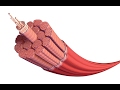
Muscle Contraction Mechanisms and Functions

Interactive Video
•
Biology, Science, Physical Ed
•
9th - 12th Grade
•
Practice Problem
•
Hard

Aiden Montgomery
FREE Resource
Read more
10 questions
Show all answers
1.
MULTIPLE CHOICE QUESTION
30 sec • 1 pt
Which type of muscle tissue is under voluntary control?
Cardiac muscle
Smooth muscle
Skeletal muscle
Involuntary muscle
2.
MULTIPLE CHOICE QUESTION
30 sec • 1 pt
What are skeletal muscles primarily composed of?
Bone cells
Blood vessels
Muscle fibers
Nerve fibers
3.
MULTIPLE CHOICE QUESTION
30 sec • 1 pt
What gives skeletal muscle its striated appearance?
Randomly arranged fibers
Uniform protein filaments
Alternating thick and thin protein filaments
Smooth muscle fibers
4.
MULTIPLE CHOICE QUESTION
30 sec • 1 pt
What is the role of the myosin head during muscle contraction?
It blocks binding sites
It stores ATP
It releases calcium ions
It binds to actin and pulls it
5.
MULTIPLE CHOICE QUESTION
30 sec • 1 pt
What triggers the power stroke in muscle contraction?
Binding of tropomyosin
Release of calcium ions
Depolarization of the membrane
Hydrolysis of ATP
6.
MULTIPLE CHOICE QUESTION
30 sec • 1 pt
How do calcium ions regulate muscle contraction?
By depolarizing the muscle fiber
By binding to troponin and exposing binding sites
By blocking ATP
By binding to myosin
7.
MULTIPLE CHOICE QUESTION
30 sec • 1 pt
Where are calcium ions stored in muscle cells?
In the neuromuscular junction
In the nucleus
In the sarcoplasmic reticulum
In the mitochondria
Access all questions and much more by creating a free account
Create resources
Host any resource
Get auto-graded reports

Continue with Google

Continue with Email

Continue with Microsoft
or continue with

%20(1).png)
Apple

Others
By signing up, you agree to our Terms of Service & Privacy Policy
Already have an account?


