
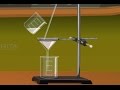
Soap-Making Process and Chemistry

Interactive Video
•
Chemistry, Science
•
6th - 10th Grade
•
Practice Problem
•
Hard

Ethan Morris
FREE Resource
Read more
7 questions
Show all answers
1.
MULTIPLE CHOICE QUESTION
30 sec • 1 pt
Which of the following is NOT required for the saponification process?
Hydrochloric acid
Glass beakers
Common salt
Measuring cylinders
2.
MULTIPLE CHOICE QUESTION
30 sec • 1 pt
What is the purpose of stirring the mixture of coconut oil and NaOH solution?
To separate the oil from the solution
To ensure a thorough reaction
To change the color of the mixture
To cool down the mixture
3.
MULTIPLE CHOICE QUESTION
30 sec • 1 pt
Why does the beaker become warm during the mixing process?
Due to an endothermic reaction
Because of the cooling effect of NaOH
Because of the heat from the Bunsen burner
Due to an exothermic reaction
4.
MULTIPLE CHOICE QUESTION
30 sec • 1 pt
What indicates that the soap solution is basic in nature?
The solution turns red litmus paper blue
The solution turns blue litmus paper red
The solution remains colorless
The solution turns blue litmus paper green
5.
MULTIPLE CHOICE QUESTION
30 sec • 1 pt
What is the role of common salt in the soap-making process?
To precipitate the soap
To dissolve the soap
To neutralize the soap
To color the soap
6.
MULTIPLE CHOICE QUESTION
30 sec • 1 pt
How is the soap separated from the mixture after adding common salt?
By heating the mixture
By using a centrifuge
By filtering through a funnel
By evaporating the liquid
7.
MULTIPLE CHOICE QUESTION
30 sec • 1 pt
What is the final step in the soap-making process?
Heating the soap
Cutting the soap into desired shapes
Mixing the soap with more NaOH
Adding more common salt
Access all questions and much more by creating a free account
Create resources
Host any resource
Get auto-graded reports

Continue with Google

Continue with Email

Continue with Classlink

Continue with Clever
or continue with

Microsoft
%20(1).png)
Apple

Others
Already have an account?


