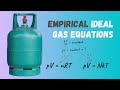
Understanding the Ideal Gas Law

Interactive Video
•
Physics, Chemistry, Science
•
9th - 12th Grade
•
Practice Problem
•
Hard

Amelia Wright
FREE Resource
Read more
9 questions
Show all answers
1.
MULTIPLE CHOICE QUESTION
30 sec • 1 pt
What are the macroscopic properties of an ideal gas?
Temperature, density, and mass
Pressure, mass, and density
Mass, density, and volume
Volume, temperature, and pressure
2.
MULTIPLE CHOICE QUESTION
30 sec • 1 pt
What does the ideal gas equation relate?
Temperature, mass, and volume
Volume, density, and pressure
Mass, density, and temperature
Pressure, volume, and temperature
3.
MULTIPLE CHOICE QUESTION
30 sec • 1 pt
In the equation PV = nRT, what does 'n' represent?
Boltzmann constant
Number of molecules
Amount of gas in moles
Molar gas constant
4.
MULTIPLE CHOICE QUESTION
30 sec • 1 pt
What is the value of the molar gas constant R?
6.02 x 10^23 mol^-1
9.81 m/s^2
1.38 x 10^-23 J/K
8.31 J/mol K
5.
MULTIPLE CHOICE QUESTION
30 sec • 1 pt
In the equation PV = NkT, what does 'k' stand for?
Avogadro constant
Gravitational constant
Molar gas constant
Boltzmann constant
6.
MULTIPLE CHOICE QUESTION
30 sec • 1 pt
What is the value of the Boltzmann constant?
9.81 m/s^2
6.02 x 10^23 mol^-1
1.38 x 10^-23 J/K
8.31 J/mol K
7.
MULTIPLE CHOICE QUESTION
30 sec • 1 pt
How can the number of molecules in a gas be calculated?
By dividing the mass by the molar mass
By multiplying the amount of gas in moles by the Avogadro constant
By adding the pressure and volume
By subtracting the temperature from the pressure
Access all questions and much more by creating a free account
Create resources
Host any resource
Get auto-graded reports

Continue with Google

Continue with Email

Continue with Classlink

Continue with Clever
or continue with

Microsoft
%20(1).png)
Apple

Others
Already have an account?
Popular Resources on Wayground

15 questions
Fractions on a Number Line

Quiz
•
3rd Grade
20 questions
Equivalent Fractions
Quiz
•
3rd Grade
25 questions
Multiplication Facts
Quiz
•
5th Grade
22 questions
fractions
Quiz
•
3rd Grade
20 questions
Main Idea and Details
Quiz
•
5th Grade
20 questions
Context Clues
Quiz
•
6th Grade
15 questions
Equivalent Fractions
Quiz
•
4th Grade
20 questions
Figurative Language Review
Quiz
•
6th Grade
Discover more resources for Physics
37 questions
Electricity Review
Quiz
•
9th Grade
10 questions
Exit Check 2.4 - 2nd Law Graphs
Quiz
•
9th Grade
10 questions
Exit Check 2.2 - 3rd Law
Quiz
•
9th Grade
10 questions
Exit Check 2.3 - 2nd Law
Quiz
•
9th Grade
10 questions
Exit Check 2.1 - 1st Law
Quiz
•
9th Grade
18 questions
Universal Law of Gravitation

Lesson
•
11th Grade
20 questions
Potential and Kinetic Energy
Quiz
•
9th - 12th Grade
34 questions
Energy Review
Quiz
•
9th - 12th Grade