
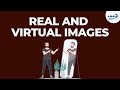
Understanding Virtual and Real Images

Interactive Video
•
Physics, Science
•
6th - 10th Grade
•
Practice Problem
•
Hard

Olivia Brooks
FREE Resource
Read more
10 questions
Show all answers
1.
MULTIPLE CHOICE QUESTION
30 sec • 1 pt
What is a characteristic feature of a plane mirror?
It forms real images.
It has a curved surface.
It has a flat reflecting surface.
It is used for magnification.
2.
MULTIPLE CHOICE QUESTION
30 sec • 1 pt
Why are we able to see our image in a plane mirror?
Due to the reflection of light.
Because of the refraction of light.
Due to the absorption of light.
Because of the diffraction of light.
3.
MULTIPLE CHOICE QUESTION
30 sec • 1 pt
What is a virtual image?
An image formed by converging light rays.
An image that is always inverted.
An image that appears to be behind the mirror.
An image formed on the same side as the object.
4.
MULTIPLE CHOICE QUESTION
30 sec • 1 pt
How are virtual images formed in a plane mirror?
By converging light rays.
By diverging light rays.
By refracted light rays.
By absorbed light rays.
5.
MULTIPLE CHOICE QUESTION
30 sec • 1 pt
What type of mirror is used to form real images?
Plane mirror
Convex mirror
Concave mirror
Cylindrical mirror
6.
MULTIPLE CHOICE QUESTION
30 sec • 1 pt
What is a key characteristic of real images formed by concave mirrors?
They are always inverted.
They are always smaller than the object.
They are always virtual.
They are always upright.
7.
MULTIPLE CHOICE QUESTION
30 sec • 1 pt
Where are real images formed in relation to the mirror?
Above the mirror
Below the mirror
Behind the mirror
On the same side as the object
Access all questions and much more by creating a free account
Create resources
Host any resource
Get auto-graded reports

Continue with Google

Continue with Email

Continue with Classlink

Continue with Clever
or continue with

Microsoft
%20(1).png)
Apple

Others
Already have an account?

