
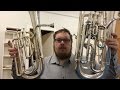
Understanding Euphonium and Baritone

Interactive Video
•
Performing Arts
•
6th - 12th Grade
•
Practice Problem
•
Hard

Ethan Morris
Used 1+ times
FREE Resource
Read more
10 questions
Show all answers
1.
MULTIPLE CHOICE QUESTION
30 sec • 1 pt
What is a common misconception about the number of valves on a baritone and a euphonium?
Euphonium has no valves.
Euphonium always has three valves.
Baritone always has four valves.
Baritone has three valves, euphonium has four valves.
2.
MULTIPLE CHOICE QUESTION
30 sec • 1 pt
In which key is the baritone pitched?
E-flat
B-flat
G
C
3.
MULTIPLE CHOICE QUESTION
30 sec • 1 pt
What is a notable feature of the baritone's role in a brass band?
It blends in as a harmony instrument.
It is primarily a bass instrument.
It often plays the melody.
It is the loudest instrument.
4.
MULTIPLE CHOICE QUESTION
30 sec • 1 pt
How do the euphonium and baritone differ in terms of tubing?
Baritone's tubing is more conical.
Euphonium's tubing is more conical.
Euphonium has shorter tubing.
Baritone has wider tubing.
5.
MULTIPLE CHOICE QUESTION
30 sec • 1 pt
What is a key difference in sound production between the euphonium and baritone?
Baritone is louder.
Euphonium requires less air.
Euphonium requires more air and produces a fuller sound.
Baritone produces a fuller sound.
6.
MULTIPLE CHOICE QUESTION
30 sec • 1 pt
Which instrument is known for having the most technically demanding music in a brass band?
Baritone
Euphonium
Trumpet
Trombone
7.
MULTIPLE CHOICE QUESTION
30 sec • 1 pt
How does the euphonium fit into the four-part model of a brass band?
It is a tenor instrument.
It is a soprano instrument.
It is a bass instrument.
It is considered a fifth part.
Access all questions and much more by creating a free account
Create resources
Host any resource
Get auto-graded reports

Continue with Google

Continue with Email

Continue with Classlink

Continue with Clever
or continue with

Microsoft
%20(1).png)
Apple

Others
Already have an account?

