
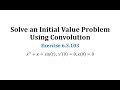
Trigonometric Identities and Laplace Transforms

Interactive Video
•
Mathematics, Science
•
10th - 12th Grade
•
Practice Problem
•
Hard

Ethan Morris
FREE Resource
Read more
10 questions
Show all answers
1.
MULTIPLE CHOICE QUESTION
30 sec • 1 pt
What is the initial value problem that needs to be solved?
X'' + x = cos(t)
X'' + x = sin(t)
X'' - x = sin(t)
X'' - x = cos(t)
2.
MULTIPLE CHOICE QUESTION
30 sec • 1 pt
What is the Laplace transform of X''?
sX(s) - X(0)
s^2X(s) - sX(0) - X'(0)
s^2X(s) + sX(0) + X'(0)
sX(s) + X(0)
3.
MULTIPLE CHOICE QUESTION
30 sec • 1 pt
How does the equation simplify using the initial conditions?
s^2X(s) - X(s) = 1/(s^2 + 1)
sX(s) + X(s) = 1/(s^2 + 1)
s^2X(s) + X(s) = 1/(s^2 + 1)
s^2X(s) + X(s) = 0
4.
MULTIPLE CHOICE QUESTION
30 sec • 1 pt
What is the form of X(s) after solving the equation?
s/(s^2 + 1)
s/(s^2 + 1)^2
1/(s^2 + 1)
1/(s^2 + 1)^2
5.
MULTIPLE CHOICE QUESTION
30 sec • 1 pt
What is the inverse Laplace transform of 1/(s^2 + 1)?
t
e^t
cos(t)
sin(t)
6.
MULTIPLE CHOICE QUESTION
30 sec • 1 pt
What is the convolution of f(t) and g(t) when both are sin(t)?
Integral from 0 to t of cos(tau) d(tau)
Integral from 0 to t of cos(tau)cos(t-tau) d(tau)
Integral from 0 to t of sin(tau) d(tau)
Integral from 0 to t of sin(tau)sin(t-tau) d(tau)
7.
MULTIPLE CHOICE QUESTION
30 sec • 1 pt
Which trigonometric identity is used to simplify the convolution integral?
cos(x)cos(y) = 1/2[cos(x-y) + cos(x+y)]
sin(x)sin(y) = 1/2[cos(x-y) - cos(x+y)]
cos(x) + cos(y) = 2cos((x+y)/2)cos((x-y)/2)
sin(x) + sin(y) = 2sin((x+y)/2)cos((x-y)/2)
Access all questions and much more by creating a free account
Create resources
Host any resource
Get auto-graded reports

Continue with Google

Continue with Email

Continue with Classlink

Continue with Clever
or continue with

Microsoft
%20(1).png)
Apple

Others
Already have an account?

