
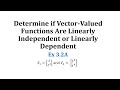
Understanding Linear Independence and Dependence of Vector-Valued Functions

Interactive Video
•
Mathematics
•
10th - 12th Grade
•
Practice Problem
•
Hard
Standards-aligned

Aiden Montgomery
FREE Resource
Standards-aligned
Read more
10 questions
Show all answers
1.
MULTIPLE CHOICE QUESTION
30 sec • 1 pt
What is the condition for vector-valued functions to be linearly independent?
C1 through Cn equals zero for some values of T
C1 through Cn equals one for some values of T
C1 through Cn equals zero for all values of T
C1 through Cn equals one for all values of T
Tags
CCSS.8.EE.C.8B
2.
MULTIPLE CHOICE QUESTION
30 sec • 1 pt
In the context of vector-valued functions, what does the zero vector represent?
A vector with alternating zero and one components
A vector with all components equal to zero
A vector with all components equal to two
A vector with all components equal to one
3.
MULTIPLE CHOICE QUESTION
30 sec • 1 pt
What does a row of zeros in the reduced echelon form of a matrix indicate?
A single solution
An infinite number of solutions
No solution
A unique solution
Tags
CCSS.8.EE.C.8B
4.
MULTIPLE CHOICE QUESTION
30 sec • 1 pt
If C1 equals negative four times C2, what can be inferred about the system of equations?
The system is inconsistent
The system has no solutions
The system has a unique solution
The system has infinitely many solutions
5.
MULTIPLE CHOICE QUESTION
30 sec • 1 pt
What is the Ronskian used for in the context of vector-valued functions?
To calculate eigenvalues
To find the inverse of a matrix
To determine linear independence or dependence
To solve differential equations
6.
MULTIPLE CHOICE QUESTION
30 sec • 1 pt
What does a zero determinant of the Ronskian indicate about the vector-valued functions?
They are linearly independent
They are linearly dependent
They are orthogonal
They are parallel
7.
MULTIPLE CHOICE QUESTION
30 sec • 1 pt
How is the determinant of a 2x2 matrix calculated?
By adding the products of the diagonals
By subtracting the product of the diagonals
By multiplying the sum of the diagonals
By dividing the product of the diagonals
Access all questions and much more by creating a free account
Create resources
Host any resource
Get auto-graded reports

Continue with Google

Continue with Email

Continue with Microsoft
or continue with

%20(1).png)
Apple

Others
Already have an account?

