
- Resource Library
- Math
- Sequences And Series
- Arithmetic Series
- Arithmetic Series Concepts And Calculations
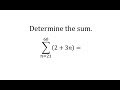
Arithmetic Series Concepts and Calculations

Interactive Video
•
Mathematics
•
7th - 10th Grade
•
Practice Problem
•
Easy
Standards-aligned

Ethan Morris
Used 1+ times
FREE Resource
Standards-aligned
Read more
10 questions
Show all answers
1.
MULTIPLE CHOICE QUESTION
30 sec • 1 pt
What is the common difference in the arithmetic series given in the problem?
2
3
5
6
Tags
CCSS.HSF.BF.A.2
2.
MULTIPLE CHOICE QUESTION
30 sec • 1 pt
What is the first term of the series when n equals 21?
63
65
68
66
Tags
CCSS.HSF.BF.A.2
3.
MULTIPLE CHOICE QUESTION
30 sec • 1 pt
How do you calculate the common difference in an arithmetic series?
Multiply any term by the next term
Add any term to the next term
Subtract any term from the next term
Divide any term by the next term
Tags
CCSS.HSF.BF.A.2
4.
MULTIPLE CHOICE QUESTION
30 sec • 1 pt
What is the last term of the series when n equals 60?
180
182
185
190
Tags
CCSS.HSF.BF.A.2
5.
MULTIPLE CHOICE QUESTION
30 sec • 1 pt
How many terms are there in the series from n equals 21 to 60?
38
41
40
39
6.
MULTIPLE CHOICE QUESTION
30 sec • 1 pt
Why do we add one when calculating the number of terms in the series?
To account for the last term
To account for both the first and last terms
To account for the middle term
To account for the first term
7.
MULTIPLE CHOICE QUESTION
30 sec • 1 pt
What is the formula used to calculate the sum of an arithmetic series?
S = n * (a1 + an)
S = n/2 * (a1 + an)
S = n * (a1 - an)
S = n/2 * (a1 - an)
Access all questions and much more by creating a free account
Create resources
Host any resource
Get auto-graded reports

Continue with Google

Continue with Email

Continue with Microsoft
or continue with

%20(1).png)
Apple

Others
By signing up, you agree to our Terms of Service & Privacy Policy
Already have an account?

