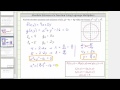
Understanding Extrema and Lagrange Multipliers

Interactive Video
•
Mathematics
•
11th Grade - University
•
Practice Problem
•
Hard
Standards-aligned

Aiden Montgomery
FREE Resource
Standards-aligned
Read more
10 questions
Show all answers
1.
MULTIPLE CHOICE QUESTION
30 sec • 1 pt
What is the first step in finding the absolute extrema of a function within a bounded region?
Find the critical points and evaluate the function at these points.
Use the method of Lagrange multipliers.
Calculate the second derivative of the function.
Graph the function and identify the highest and lowest points.
2.
MULTIPLE CHOICE QUESTION
30 sec • 1 pt
What do you need to calculate to find the critical points of a function?
The gradient of the function.
The integral of the function.
The first order partial derivatives.
The second derivative of the function.
3.
MULTIPLE CHOICE QUESTION
30 sec • 1 pt
Why does the function f(x, y) = 4x + 5y have no critical points in the bounded region?
Because the function is not differentiable.
Because the function is linear.
Because the partial derivatives are constants and never zero.
Because the partial derivatives are zero.
4.
MULTIPLE CHOICE QUESTION
30 sec • 1 pt
What is the purpose of using Lagrange multipliers in finding extrema?
To approximate the function values.
To find extrema on the boundary of the region.
To solve the function using calculus one techniques.
To find critical points inside the region.
5.
MULTIPLE CHOICE QUESTION
30 sec • 1 pt
What condition must be met for the gradients of f and g in the Lagrange multipliers method?
They must be zero.
They must be parallel.
They must be equal.
They must be perpendicular.
6.
MULTIPLE CHOICE QUESTION
30 sec • 1 pt
In the context of Lagrange multipliers, what does it mean when the level curves of f and g are tangent?
The gradients are perpendicular.
The gradients are parallel.
The function has no extrema.
The function is undefined.
7.
MULTIPLE CHOICE QUESTION
30 sec • 1 pt
What is the constraint equation used in the Lagrange multipliers method for this problem?
x^2 + y^2 = 4
x^2 + y^2 = 16
4x + 5y = 0
x + y = 0
Access all questions and much more by creating a free account
Create resources
Host any resource
Get auto-graded reports

Continue with Google

Continue with Email

Continue with Classlink

Continue with Clever
or continue with

Microsoft
%20(1).png)
Apple

Others
Already have an account?
Popular Resources on Wayground

15 questions
Fractions on a Number Line

Quiz
•
3rd Grade
20 questions
Equivalent Fractions
Quiz
•
3rd Grade
25 questions
Multiplication Facts
Quiz
•
5th Grade
22 questions
fractions
Quiz
•
3rd Grade
20 questions
Main Idea and Details
Quiz
•
5th Grade
20 questions
Context Clues
Quiz
•
6th Grade
15 questions
Equivalent Fractions
Quiz
•
4th Grade
20 questions
Figurative Language Review
Quiz
•
6th Grade
Discover more resources for Mathematics
12 questions
Add and Subtract Polynomials
Quiz
•
9th - 12th Grade
13 questions
Model Exponential Growth and Decay Scenarios
Quiz
•
9th - 12th Grade
27 questions
7.2.3 Quadrilateral Properties
Quiz
•
9th - 12th Grade
10 questions
Key Features of Quadratic Functions
Interactive video
•
8th - 12th Grade
11 questions
Exponent Quotient Rules A1 U7
Quiz
•
9th - 12th Grade
18 questions
Integer Operations
Quiz
•
5th - 12th Grade
15 questions
Exponential Growth and Decay Word Problems
Quiz
•
9th - 12th Grade
10 questions
complementary and Supplementary angles
Quiz
•
9th - 12th Grade