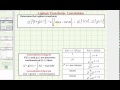
Laplace Transform and Convolution Theorem

Interactive Video
•
Mathematics, Science
•
10th Grade - University
•
Practice Problem
•
Hard

Lucas Foster
FREE Resource
Read more
10 questions
Show all answers
1.
MULTIPLE CHOICE QUESTION
30 sec • 1 pt
What is the main goal of the problem discussed in the video?
To find the Laplace transform of a given integral.
To solve a differential equation.
To calculate the Fourier transform.
To determine the inverse Laplace transform.
2.
MULTIPLE CHOICE QUESTION
30 sec • 1 pt
What does the convolution theorem help us determine?
The Laplace transform of a convolution.
The inverse of a function.
The derivative of a function.
The integral of a function.
3.
MULTIPLE CHOICE QUESTION
30 sec • 1 pt
What is the Laplace transform of the convolution of f and g?
The difference of the Laplace transforms of f and g.
The sum of the Laplace transforms of f and g.
The quotient of the Laplace transforms of f and g.
The product of the Laplace transforms of f and g.
4.
MULTIPLE CHOICE QUESTION
30 sec • 1 pt
In the context of the video, what is f(x) identified as?
x^2
sine x
cos x
e^x
5.
MULTIPLE CHOICE QUESTION
30 sec • 1 pt
What is g(x) identified as in the video?
e^x
sine x
x^2
cos x
6.
MULTIPLE CHOICE QUESTION
30 sec • 1 pt
What is the Laplace transform of sine x according to the table?
s / (s - 1)
1 / (s^2 + 1)
1 / (s - 1)
s / (s^2 + 1)
7.
MULTIPLE CHOICE QUESTION
30 sec • 1 pt
What is the Laplace transform of e^x as per the table?
1 / (s - 1)
s / (s + 1)
1 / (s + 1)
s / (s - 1)
Access all questions and much more by creating a free account
Create resources
Host any resource
Get auto-graded reports

Continue with Google

Continue with Email

Continue with Classlink

Continue with Clever
or continue with

Microsoft
%20(1).png)
Apple

Others
Already have an account?
Popular Resources on Wayground

15 questions
Fractions on a Number Line

Quiz
•
3rd Grade
20 questions
Equivalent Fractions
Quiz
•
3rd Grade
25 questions
Multiplication Facts
Quiz
•
5th Grade
54 questions
Analyzing Line Graphs & Tables
Quiz
•
4th Grade
22 questions
fractions
Quiz
•
3rd Grade
20 questions
Main Idea and Details
Quiz
•
5th Grade
20 questions
Context Clues
Quiz
•
6th Grade
15 questions
Equivalent Fractions
Quiz
•
4th Grade
Discover more resources for Mathematics
18 questions
SAT Prep: Ratios, Proportions, & Percents
Quiz
•
9th - 10th Grade
12 questions
Parallel Lines Cut by a Transversal
Quiz
•
10th Grade
12 questions
Add and Subtract Polynomials
Quiz
•
9th - 12th Grade
10 questions
Elijah McCoy: Innovations and Impact in Black History
Interactive video
•
6th - 10th Grade
16 questions
Converting Improper Fractions to Mixed Numbers
Quiz
•
4th - 10th Grade
15 questions
Intro to Trig Ratios
Quiz
•
10th Grade
10 questions
Solving One Step Equations: Key Concepts and Techniques
Interactive video
•
6th - 10th Grade
12 questions
Triangle Inequality Theorem
Quiz
•
10th Grade